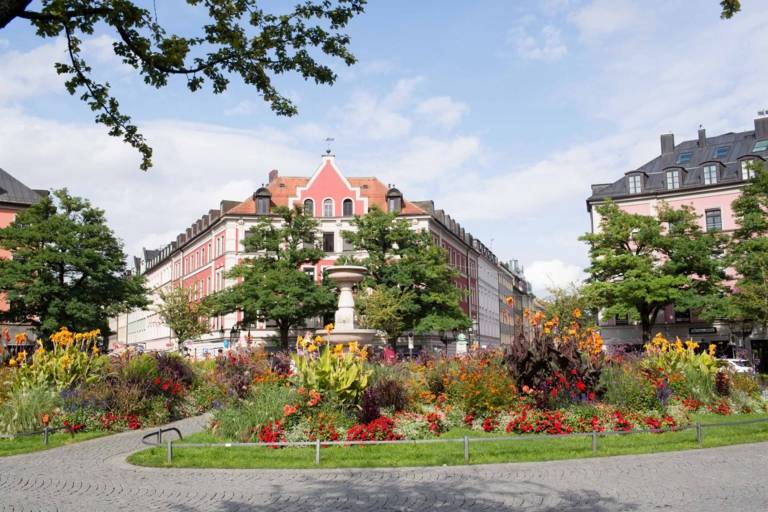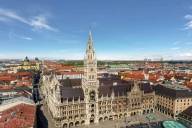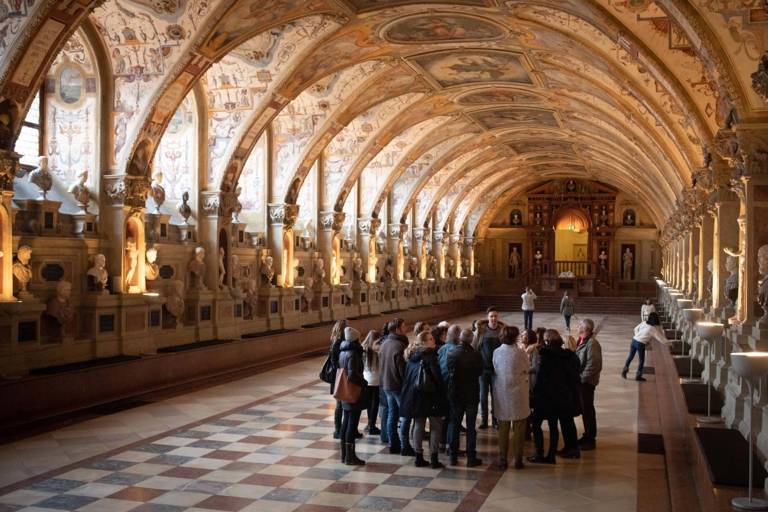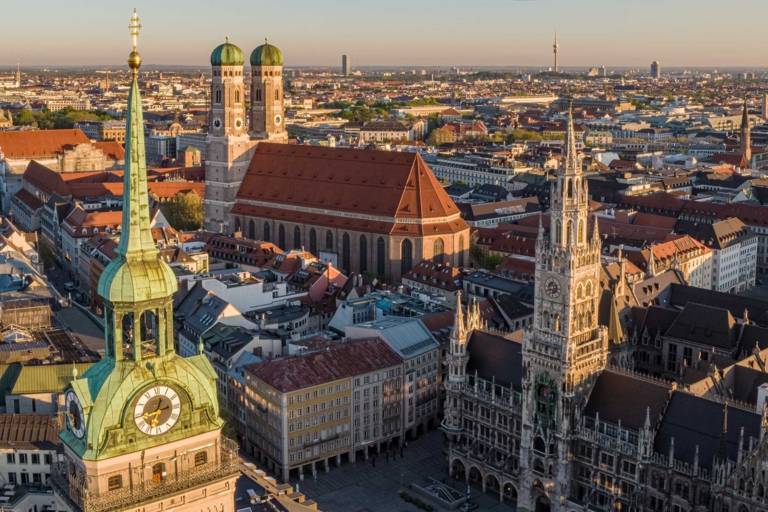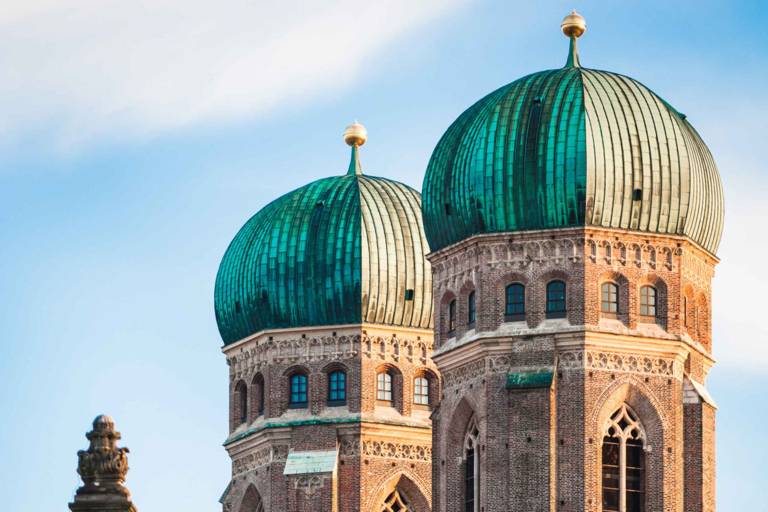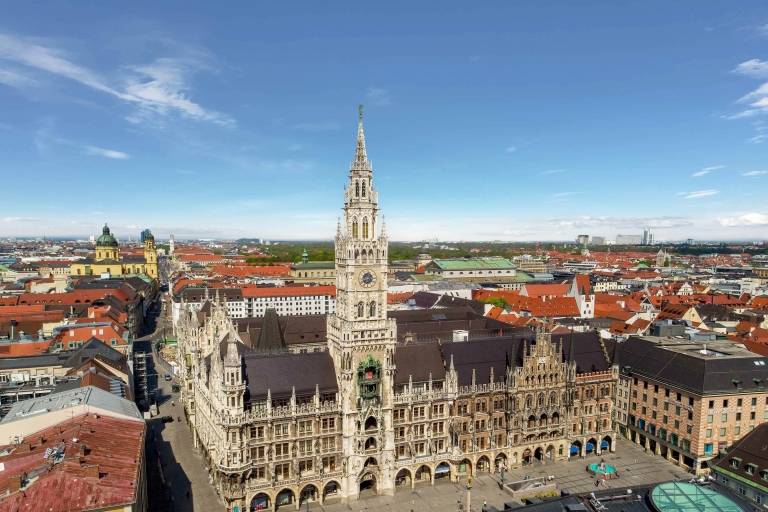
Munich is regarded as Germany's start-up capital. A stroll through the Maxvorstadt district reveals its remarkable innovative strength. Alongside the two universities, Ludwig-Maximilians-Universität (LMU) and the Technical University of Munich (TUM), the district is home to numerous institutions and major companies that support bright minds in shaping the future and driving progress. Many of them are also open to visitors.
- Siemens AG
- Strascheg Center for Entrepreneurship (SCE)
- Technical University of Munich (TUM)
- Celonis
- Munich Urban Colab
- acatech –German Academy of Science and Engineering
- Google
- Apple
- Ludwig-Maximilians-Universität (LMU)
Even a global player like Siemens had humble beginnings: In a Berlin backyard, where company founder Werner von Siemens worked on a solution for his pointer telegraph some 180 years ago. Electrical telegraphs, such as Siemens' first product, revolutionised communications technology in the mid-19th century.
In addition to Berlin, Munich is now home to one of the two headquarters of Siemens AG, a leading technology company specialising in industry, infrastructure, mobility and healthcare. To mark the 200th anniversary of Werner von Siemens' birth, the new Siemens headquarters was opened in 2016 at the transition between Munich's Old Town and the Maxvorstadt district. Its architecture bridges the company's past and future. The Danish architectural firm Henning Larsen Architects has skilfully integrated the historic Palais Ludwig Ferdinand into the modern new building. The resulting complex is regarded as the flagship project for sustainability and energy efficiency.
“When you walk through our headquarters on Wittelsbacherplatz, you soon realise: this isn't a traditional corporate headquarters, but an integral part of the city. Innovation is evident here not only in our technologies, but also in the way we work and the way we conceive of spaces.”
Around 1,700 employees work here across approximately 45,000 square metres of floor space. The company's mission is to develop technology that makes factories more efficient, cities more liveable and transport more sustainable. A particularly impressive example of sustainable energy supply takes us to extreme environments in the Swiss Alps: At an altitude of 2,993 metres, the Monte Rosa Hut generates more than 90 per cent of its own energy requirements thanks to a photovoltaic system integrated into the south-facing façade, solar thermal collectors and a building management system from Siemens.
As one of the leaders in the field of industrial artificial intelligence, the company also develops AI solutions for customers across all sectors. In addition, Siemens holds a stake in the listed company Siemens Healthineers, a leading global provider of medical technology that is driving groundbreaking developments in the healthcare sector.
Siemens AG, Werner-von-Siemens-Strasse 1
The ground floor of the modern corporate headquarters, with its green courtyards, water feature, café and restaurant, is freely accessible to everyone. In a shop window in the passageway next to the main entrance, a replica of the historic first Siemens workshop in Berlin is on display, complete with a pointer telegraph. The new Siemens building is also a venue for contemporary art: A bronze sculpture by Georg Baselitz (1938–2026) entitled “Schwesterngruppe” is prominently placed in the atrium. It was unveiled by the artist himself at the opening ceremony.
In front of the main entrance, visitors can admire Daniel Libeskind's work “The Wings”. Two further 10-metre-high aluminium sculptures of this kind were erected in Berlin and Erlangen, symbolising the connection between Siemens' locations in Germany. LEDs on the surfaces can be used to create lighting effects. Both artworks offer a foretaste of the artistic experiences that await visitors in the world-renowned Pinakotheken (art galleries) and museums in the Kunstareal (art quarter) of the neighbouring Maxvorstadt district.
Leo von Klenze – Ludwig I's royal court architect – lived for 25 years in the historic part of the company's headquarters, the Neoclassical Palais Ludwig Ferdinand, which he designed himself. He was also responsible for the buildings along neighbouring Ludwigstrasse, commissioned by the king. The grand staircase leading to the entrance has become a popular Instagram photo spot in Munich.
Just round the corner from the palace, a commemorative plaque marks the place where FC Bayern Munich was founded in 1900. However, Café Gisela, where the 17 founding members signed the original charter, no longer exists. FC Bayern fans can still admire a replica of the founding charter at the FC Bayern Museum in the Allianz Arena (football stadium) and visit Café Gisela there, which carries on the name and tradition of the original café.
The Strascheg Center for Entrepreneurship (SCE) is the entrepreneurship centre at Munich University of Applied Sciences and is one of the city's key hubs for start-ups and innovation. Here, students, founders and companies learn how to turn ideas into new products, services and start-ups. The SCE brings together education, research and practical application: In workshops, projects and support programmes, participants develop innovative solutions to technological, social and environmental challenges.
“At the SCE, we empower students, start-up founders and businesses to develop ideas, bring innovations to life and network within ecosystems – so that together we can actively shape the future.”
At the same time, the SCE connects talent, start-ups, companies and experts from Munich and around the world. Through its work, it helps ensure that Munich ranks among Europe's leading innovation and start-up locations. SCE alumni have founded successful ventures such as the holiday home booking portal “Holidu”, the AI-powered “omegga” method for determining sex at the embryonic stage, and “curevision”, a medical application for digital 3D wound analysis.
Many more promising ideas are already in the pipeline. The two students on the Entrepreneurship Master’s programme at the SCE – Johannes from the “bikehero” project and Johanna from the “Shift-Talk” team – explain their projects here, which they presented to the audience in the form of a pitch during their final presentation at the end of the second semester:
Johannes, “bikehero” project team:
“Our group is trying to establish a second-hand market for cargo bikes, because we've noticed that there is a strong trend towards green mobility, especially in Munich. This means that cargo bikes are becoming increasingly attractive, particularly for families. We work with partner workshops in various German cities that repair used bikes – not for the end customer, but for us as a platform, an online refurbishment marketplace, so that we – unlike platforms such as eBay – can offer young families in Munich, Berlin or Hamburg second-hand, but professionally serviced and repaired cargo bikes at an affordable price and with a warranty.”
Johanna, “Shift-Talk” project team:
“Due to a driver shortage, many public transport operators are turning to international recruitment and bringing drivers from abroad to Germany. Most of these drivers already have German language skills at A2 or B1 level, but we have found that there is a great deal of miscommunication, because they are simply not prepared for the job-specific language they need for their work as bus drivers. We are developing a solution: a platform that teaches them precisely this language through short, scenario-based lessons, so that they can integrate more quickly into their day-to-day work as bus drivers, make fewer mistakes and, ideally, stay with the company for longer.”
Strascheg Center for Entrepreneurship (SCE), Hessstraße 89
Anyone wishing to gain an insight into the world of start-ups can visit the SCE InnovationsCafé – a free, monthly networking event where visitors can meet founders, discover new ideas and experience the Munich start-up scene at first hand. No prior knowledge is required. Dates and further information are available here.
The “Königliche Neue Polytechnische Schule München” (Royal New Polytechnic School of Munich), predecessor of today's Technische Universität München (Technical University of Munich), was founded by none other than King Ludwig II. Alongside the construction of his fairytale castles, he was a staunch advocate of technological progress. Incidentally, his grandiose buildings were fitted with devices that featured visionary technology that was cutting-edge for its time. He also chose the location of what is now TUM's main campus in Maxvorstadt and commissioned architect Gottfried von Neureuther.
TUM is one of Germany's “Universities of Excellence” – a distinction it has held continuously since 2006. The title is awarded to universities that conduct outstanding research, promote the next generation of academics and present forward-looking concepts for tackling global societal challenges.
From the very first day of their studies, students at TUM are encouraged to establish their own businesses through a comprehensive entrepreneurship programme. To support this, the non-profit UnternehmerTUM GmbH was founded in Garching in 2002. Today, it is Europe's leading centre for entrepreneurship and innovation and also operates a second location in the heart of Munich at Munich Urban Colab.
In the 2025/26 winter semester, around 52,000 students were enrolled at TUM across 177 degree programmes, including 45 per cent international students from 140 countries worldwide. Since its foundation, TUM has produced 19 Nobel laureates and, more recently, 22 “unicorns” – start-up companies that have achieved a valuation of at least one billion US dollars.
UnternehmerTUM GmbH in Munich
UnternehmerTUM was founded in 2002 by entrepreneur Susanne Klatten in close collaboration with Prof. Dr Helmut Schönenberger and the then President of the Technical University of Munich. As a non-profit organisation, UnternehmerTUM GmbH is Europe's leading centre for start-ups and innovation, supporting more than 100 high-growth technology start-ups each year. More than 500 staff members assist with the development and financing of start-ups.
The aim is to tackle societal challenges such as climate change, the energy transition and resource scarcity through innovation. Founders are supported in bringing their ideas to life. They are assisted by experienced teams in developing their own products. At the MakerSpace, companies, start-ups and creative professionals can produce prototypes and small batches across two locations covering a total of 2,700 square metres.
In addition to its main campus in Maxvorstadt, the university operates a number of locations across the greater Munich area, including the Centre for Natural and Engineering Sciences in Garching and the Faculty of Life Sciences in Weihenstephan, a district of Freising. The Straubing campus focuses entirely on sustainability as an interdisciplinary endeavour. In Ottobrunn-Taufkirchen, the university is expanding its facility for research and teaching in the fields of aerospace, while TUM also maintains branch campuses in Heilbronn and at the international technology hub of Singapore.
Technical University of Munich (TUM), Arcistrasse 21
Due to wartime destruction, only fragments of the original Neo-Renaissance-style building from 1868 remain. However, at the TUM Architecture Museum, visitors can view photographs from the time of construction, showing what the university used to look like. The famous clock tower is part of the university's “Thierschbau” building, constructed between 1910 and 1916 by Friedrich von Thiersch at the corner of Gabelsbergerstrasse and Luisenstrasse. The tower was severely damaged and no longer exists in its original form.
Those wishing to take a look inside the university can discover Ludwig Dasio's “Golden Angel” in the staircase on the ground floor. Friedrich von Thiersch, an architect and art enthusiast, is believed to have had the figure modelled on his daughter. The sculpture is interpreted as an allegory of science.
The Vitruvius bust by the Munich sculptor Rolf Nida-Rümelin (1910–1996), located in the courtyard of the main building of the Technical University of Munich at Arcisstrasse 21, is a tribute to the Roman architect, engineer and architectural theorist Marcus Vitruvius Pollio, who lived during the first century BC.
A spectacular architectural landmark from more recent times is the TUM's vertical childcare centre on Gabelsbergerstrasse, the first building in Europe designed by star architect Prof Francis Kéré. In 2022, Kéré was awarded the Pritzker Prize, also known as the “Nobel Prize of Architecture”, and is Professor of Architectural Design and Participation at TUM. The result is a vertical playground where children can run, climb and slide from one floor to the next. At the very top, the partly covered roof terrace of the childcare centre, named “Himmelswiese” (sky meadow), invites children to move, enjoy fresh air and let their gaze wander across the city.
Tucked away in a quiet courtyard on Theresienstrasse lies the headquarters of one of Europe's most valuable software companies: Celonis. The tech pioneer's offices are spread across two buildings, from which its software solutions are revolutionising business processes worldwide. Celonis has grown at a remarkable pace since it was founded in 2011 by three TUM students. What began as a university project has developed into Germany’s first “decacorn” – a start-up valued at more than ten billion US dollars.
“Our early days at TUM continue to shape Celonis to this day. Half of our workforce here at this site – which now numbers around 1,000 – have a university background from one of the local higher education institutions. Without the talent trained there, we would not exist in this form.”
Celonis' success is based on process mining and process intelligence. In practice, this means: The Celonis software visualises business processes by analysing existing data, identifies weaknesses and bottlenecks, and suggests ways to resolve them. To do this, the software creates a detailed real-time representation of actual workflows, which can be viewed from a bird's-eye perspective. For many companies and public authorities, this is the first time they see how their processes actually work – because in reality, they often differ from how they appear in theory. This enables users to optimise their workflows and unlock hidden potential. Furthermore, Celonis software provides AI systems with the data they need to deliver reliable and efficient results.
Demand for such solutions is high across all sectors: Over 1,400 customers now rely on the technology, including around three quarters of all DAX-listed companies, international corporations such as Coca-Cola and Vodafone, as well as public sector organisations. Today, Celonis employs more than 3,000 people at over 20 locations worldwide and, in addition to its Munich base, has a second headquarters in New York.
Celonis, Theresienstrasse 6
In 2021, Munich Urban Colab – a globally unique hub for smart city solutions – opened in Kreativquartier in the heart of Munich. The initiative of UnternehmerTUM – Europe's leading centre for innovation and entrepreneurship – and the City of Munich brings together a wide range of different stakeholders under one roof: start-ups, established companies, academia, talented individuals, creative professionals and artists work here together with the city administration and residents to develop sustainable solutions for a liveable city of the future.
Sabine Hansky, Programme Director of Munich Urban Colab and an expert in urban development, has been involved from the very beginning. In the café, she answers our questions about the innovation hub, which will celebrate its fifth anniversary in 2026.
Ms Hansky, why does a city like Munich need a Munich Urban Colab?
Hansky: Cities around the world are facing major challenges. Munich is growing rapidly. By 2045, the city's population is expected to reach 1.83 million (compared with 1.603 million in 2024). This raises pressing questions for the city: How can we ensure mobility, digitalise infrastructure, plan and build sustainably, tackle climate change, manage waste and secure energy supplies? Added to this are issues such as care services and healthcare. Innovations and new technologies can help to find solutions.
However, the challenges are far too complex for any single organisation to tackle on its own: Neither Siemens, nor the city administration, nor BMW nor any start-up can manage this alone. It always requires collaboration between business, academia, politics and public administration – and, of course, a space where ideas can emerge and flourish. That is why we have created this place, where we bring all the key players together under one roof.
The Munich Urban Colab community also includes large, international companies. What do they hope to gain from this?
Hansky: Companies such as Infineon and SAP naturally have their own headquarters. What they're looking for here, however, is the chance to exchange ideas with start-ups, make contact with talented individuals and engage with the city administration. They want to stay at the forefront of developments.
And where does this interaction take place? Here in the café?
Hansky: Yes, people often bump into each other by chance here in the café, and that is precisely why a physical space is so important. It creates opportunities for unexpected encounters. This is where the spontaneous and surprising moments arise – and these are incredibly important for the emergence of new ideas and for innovation. That’s why the café is such a vital place.
But we have also created many other formats for bringing people together. These include pure networking events for the community, as well as events to which we invite the general public. For example, the “Inspiration & Talk” platform, where we discuss current topics such as artificial intelligence, loneliness, affordable housing and construction with truly outstanding experts, including leading international figures. Or the “Meet the City” series of events, in which the City of Munich regularly offers insights into new urban projects and seeks to engage in dialogue with everyone interested in a liveable city of the future.
“At Munich Urban Colab, we strive to find smart solutions for urban living. However, as a smart city, Munich should not only be digitised and connected, but should also retain its liveability. This means we must incorporate the historical heritage of this city into all our considerations.”
So, Munich Urban Colab is not just a place for specialists?
Hansky: Of course, it's important to us to be the driving force behind innovation in shaping liveable cities and to ensure that solutions developed here actually find their way into cities to benefit residents – such as the autonomous cleaning robot that was developed here and is now in use in ten cities. But this is also an important place where anyone interested is invited to take part in a dialogue about the city of the future and the question of how we want to live.
What role does the architecture of Munich Urban Colab play in this?
Hansky: We designed the building from the inside out. We wanted the architecture to create the best possible environment for interdisciplinary, cross-sector collaboration, aimed at developing and implementing innovation.
Transparency is important to us, because we are an extremely innovative and creative community here. We carefully select who becomes part of this community: people who value the exchange of experiences and knowledge and who are willing to network. This is what the building’s high level of transparency stands for: Everything is visible – you can see into the offices throughout the building.
Surely the location here, right in the heart of the Kreativquartier, wasn’t just coincidence?
Hansky: No, Munich Urban Colab has found exactly the right setting in the Kreativquartier. It is undoubtedly one of Munich's most dynamic neighbourhoods. A truly exciting urban mix of business, science and culture is emerging here – and, of course, we fit in perfectly. Solutions for the city are not developed on a greenfield site, but in places like this: right in the heart of a vibrant, urban neighbourhood.
Munich Urban Colab, Freddie-Mercury-Strasse 5
Munich Urban Colab is well worth a visit for its location alone: right in the heart of the Kreativquartier, a new, exciting and inspiring neighbourhood off the beaten track. Here, Munich is creating plenty of space for innovative ideas and projects. There's a real sense of excitement in the air: Living and working are combined with art, culture and knowledge. The 20-hectare site is situated near Olympiapark (Olympic Park), between the popular districts of Schwabing and Neuhausen.
The ground floor and first floor of Munich Urban Colab are also open to the public. A fresh spirit of innovation can be felt throughout this ultra-modern and attractive building. Form follows function. Nothing here has been left to chance. From the roller shutters – the sort typically found in car workshops and industrial premises – to the high-quality seating by renowned furniture and design manufacturers, every detail has been carefully thought through. In the entrance area, right next to the reception, simple wooden signs bearing the names of all the companies, start-ups, municipal departments and other members of the community based in the building reflect the belief that everyone meets on an equal footing and that what truly matters is collaboration between the stakeholders.
Anyone interested in the liveable city of the future can take part in a wide range of free events and discussion forums, many of which take place regularly. As part of the “Open Workshop”, members of the public can also book workspace in the superbly equipped, high-tech MakerSpace workshop. Here, where start-ups are tinkering with their prototypes, visitors can attend workshops to learn how to sew a traditional dirndl or sign up for courses that teach the safe and proper use of equipment. In between, the Flash Gordon café-restaurant is the perfect place to enjoy a good coffee or lunch. It is named after Queen's album “Flash Gordon” – a fitting tribute, since Munich Urban Colab is located on Freddie-Mercury-Strasse.
The ensemble of buildings at Karolinenplatz (square), now home to acatech, looks back on a rich and eventful history – a history that is reflected in its architecture. Karl von Fischer built the complex between 1809 and 1812. His vision influenced the design of the Walhalla memorial and the neighbouring Glyptothek (art gallery). He was also responsible for the construction of the Nationaltheater (opera house) and the Prinz-Carl-Palais, the former official residence of the Bavarian Minister-President. Maximilian I Joseph, the first King of Bavaria, commissioned the buildings at Karolinenplatz and was their first occupant. During the nineteenth and early twentieth centuries, the buildings were known as Palais Toerring-Seefeld.
During the Nazi dictatorship, they housed the Supreme Party Court of the NSDAP. Following their destruction in the Second World War, the buildings were reconstructed in 1946 to plans by Karl Kergl. They housed the state lottery administration – making Karolinenplatz a place where fortune resided. The fountain in the atrium, crowned by a sculpture of Fortuna, the goddess of fortune, along with many details of the décor and lighting, still bear witness to this era today.
In 2015, Karolinenplatz 4 became the headquarters of acatech – the German Academy of Science and Engineering. Funded by the German Federal Government and the Free State of Bavaria, the national academy advises policymakers and society on future-oriented issues in engineering sciences. Under the patronage of the Federal President, the academy fulfils its advisory role independently, in an evidence-based manner and with a focus on the common good.
“One of the great strengths of Germany and Europe is our determination and our ability to channel technological progress towards goals that serve the common good. Through its extensive work in providing non-partisan, interdisciplinary and cross-sectoral advice to policymakers and society on future technology policy issues, the German Academy of Science and Engineering is an institution that drives genuine progress in this sense. We need its collective expertise more urgently than ever before. For it is in the field of research and development that the future of our country and the future of Europe will be decided: how free, how prosperous and how secure our lives will be.”
More than 700 leading scientists – the members of acatech – are working together with more than 100 technology companies represented on the acatech Senate to fulfil this mission. Future energy systems, the transition to sustainable mobility, successful digital transformation and Germany's capacity for innovation are among the academy's key areas of work. The acatech FORUM provides a venue for this collaboration, while also opening its doors to public dialogue.
The building continues to write history: Yad Vashem is to establish the first Holocaust education centre outside Israel at Karolinenplatz 4. As a living memorial of the Jewish people to the Holocaust, Yad Vashem preserves the memory of the past and conveys its significance to future generations. The establishment of the first Yad Vashem education centre outside Israel is of historic significance. Given the site's dark history during the Nazi era, as well as all its present-day importance for Israeli-German and transatlantic relations and for remembrance of the Nazi era, acatech wholeheartedly supports this decision. The acatech FORUM will therefore relocate.
acatech, Karolinenplatz 4
As part of the “acatech am Dienstag” series (acatech on Tuesdays), the academy invites the public to open dialogue events and interactive activities exploring current technological issues. Together with partners such as the Kunstareal, the Deutsches Museum, Bavarian adult education centres (Volkshochschulen) and many others, acatech opens up new, unconventional and inspiring approaches to its science and engineering topics. Whether through traditional panel discussions or science slams – acatech uses a wide range of discussion formats and collaborative partnerships to make expert knowledge openly accessible and to stimulate public debate. As a result, the acatech FORUM has become an established fixture of Munich’s city life. Information on events at the acatech FORUM can be found here.
A new development hub for the global tech company is taking shape in the historic Arnulfpost building complex, which is characterised by its striking rotunda. By the end of 2026, around 30,000 square metres of office space will be completed, providing room for up to 1,500 employees. Google has therefore established its first global site for sovereign cloud solutions in Munich, making the city one of the internet giant’s most important innovation hubs in Germany – which underlines Munich's importance as a tech centre.
Google intends not only to import cloud technology, but also to further develop it in Munich and adapt it to the needs of local customers. Together with Google engineers, customers will be able to experiment with the technology and thus contribute to developing practical solutions to real-world problems. A cloud is a network of servers, storage space, databases, software and other resources that can be accessed via the internet. These resources are not operated locally on a single computer or server, but are managed in data centres by cloud providers such as Google.
Following the restoration and modernisation of the former parcel delivery office in the Maxvorstadt district, Google also plans to create public spaces and green areas around the iconic building.
Google, Arnulfstrasse 62
Arnulfpost, also known as Postpalast, was formerly the parcel post office and is a listed building. The complex was built between 1925 and 1930 by the architects Robert Vorhoelzer, Walther Schmidt and Franz Holzhammer.
The buildings are among the most striking examples of the “Postbauschule” (Postal Architecture School), which was the most important manifestation of the “Neues Bauen” (New Building) movement in Bavaria between 1920 and 1934. It was an architectural approach specialising in the design of postal buildings. Architects such as Robert Vorhoelzer believed it was important for buildings to serve people – they should therefore be functional, bright and inviting, without dominating their surroundings.
Today, especially the portal and the relief on the former post office building are of historical value. The Munich-based architectural practice Allmann Sattler Wappner has been commissioned to carry out the sensitive conversion: With sustainability in mind, the existing building is to be preserved as far as possible. Furthermore, Arnulfpost is to become a place for people to meet – not only for staff and visitors, but for all Munich residents.
Apple has been based in Munich since 1981. It is hard to believe that the company started out here more than four decades ago with just ten employees. Today, Apple operates seven locations in the Munich region, and two of the 15 Apple Stores in Germany are also situated in Munich. In the 2020s, the tech giant expanded its long-standing presence in the Bavarian capital with a new, 30,000-square-metre site on Karlstrasse in the Maxvorstadt district.
The Apple Innovation Centre there is dedicated to the research and development of semiconductors and chips. These are components in iPhones as well as Android phones and therefore essential technologies for products all over the world. In this way, the global technology company operates high-tech manufacturing right in the heart of Munich. The Innovation Centre is a tenant in ‘‘Karl‘‘, a building complex designed by the prolific English architect David Chipperfield, winner of the 2023 Pritzker Prize. Apple's presence in Munich is set to expand even further at another Maxvorstadt location: A new building is currently under construction on Seidlstrasse and will house the company's offices and laboratories.
Apple, Karlstrasse 77-79
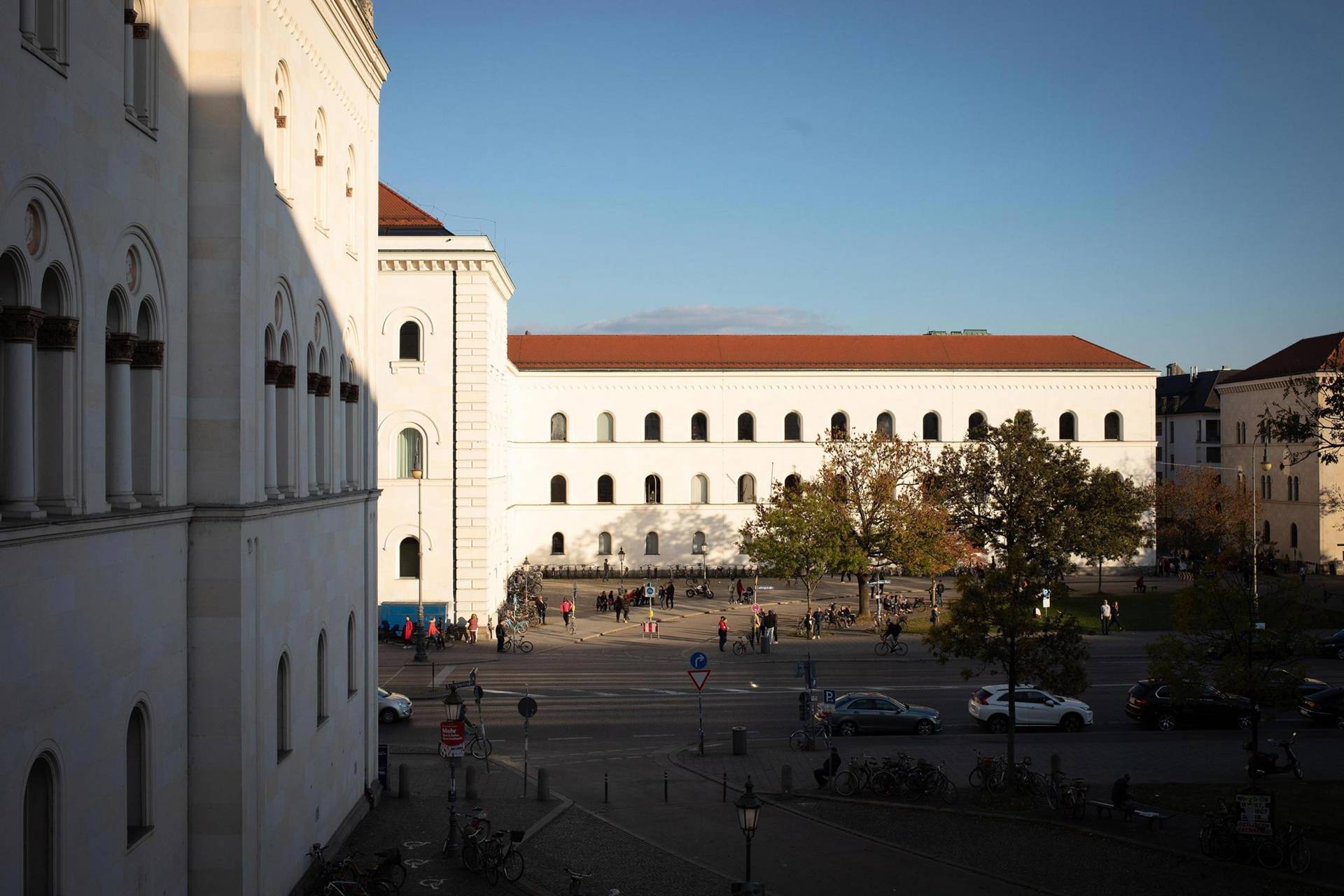
The historic main building, with its two distinctive fountains, is the landmark of LMU Munich. However, the university also includes modern teaching and research facilities, numerous libraries, hospitals, agricultural enterprises and the Wendelstein Observatory in the Bavarian Alps. In total, there are 125 buildings – in and around Munich.
LMU celebrated its 500th anniversary as early as 1972. It was founded in Ingolstadt in 1472. After another quarter of a century based in Landshut, it was relocated to Munich in 1826 at the initiative of King Ludwig I. He wanted research and teaching to take place in what was then the royal capital of the Kingdom of Bavaria. In 2027, LMU will celebrate its 555th anniversary with a special celebration.
The move into the present-day main building, designed by Friedrich von Gärtner, took place in 1840 on the King's birthday. This was the period when Ludwigstrasse was extended towards Schwabing, where, alongside the university, the parish and university church of St Ludwig and the Court and State Library were also built.
Today, LMU enjoys an outstanding international reputation. It was recently once again awarded the title of “University of Excellence”. This means that Munich's two major universities, LMU and the Technical University of Munich (TUM), are the only universities in Germany to have held this title continuously since the introduction of the federal-state funding programme 20 years ago.
The new Transfer & Entrepreneurship division at LMU was established to accelerate technology transfer. Here, everything revolves around one question: How does a great idea actually make its way from the laboratory out into the world? New technologies are to be translated into market-ready products much more quickly in the future.
In this endeavour, LMU sees itself as a partner to researchers – with processes that are as unbureaucratic and entrepreneur-friendly as possible, while promoting academic excellence. It supports young entrepreneurs in setting up their own businesses, from providing access to a network of successful entrepreneurs, mentors and, not least, investors to offering assistance with all bureaucratic and contractual matters. The Entrepreneurship & Transfer division reports directly to the Vice President for Entrepreneurship, Dr Philipp Baaske.
In the 2025/26 winter semester, around 53,000 students were enrolled at LMU. Of these, around 12,000 were from abroad. People from more than 130 countries study and work on campus. The proportion of female students is around 60 per cent. Fifty scientists who have conducted research or studied at LMU have been awarded the Nobel Prize.
“World-class research gives rise to world-class companies. That is our ambition at LMU. In our laboratories, ideas are born that have the potential to transform entire industries – from medicine and physics to AI and quantum computing. Our task is to turn this research into businesses: with less bureaucracy, more trust and an ecosystem that brings the right people together. If we succeed, it is not just Munich that benefits. We all stand to gain.”
LMU Munich is one of Germany's leading research universities, with outstanding scientific work that matches international standards or is at the forefront in many fields, particularly in medicine and life sciences, physics (in 2023, Prof. Dr Ferenc Krausz of LMU was awarded the Nobel Prize in Physics) and in the fields of artificial intelligence, quantum computing and materials research.
The university's laboratories are constantly producing innovations that have an impact far beyond academia, by pioneering diagnostic and therapeutic methods or developing new materials and technologies. LMU also ranks among the top universities in Europe in the fields of law, economics and social sciences, as well as in humanities and cultural studies.
Ludwig-Maximilians-Universität of Munich (LMU), Geschwister-Scholl-Platz 1
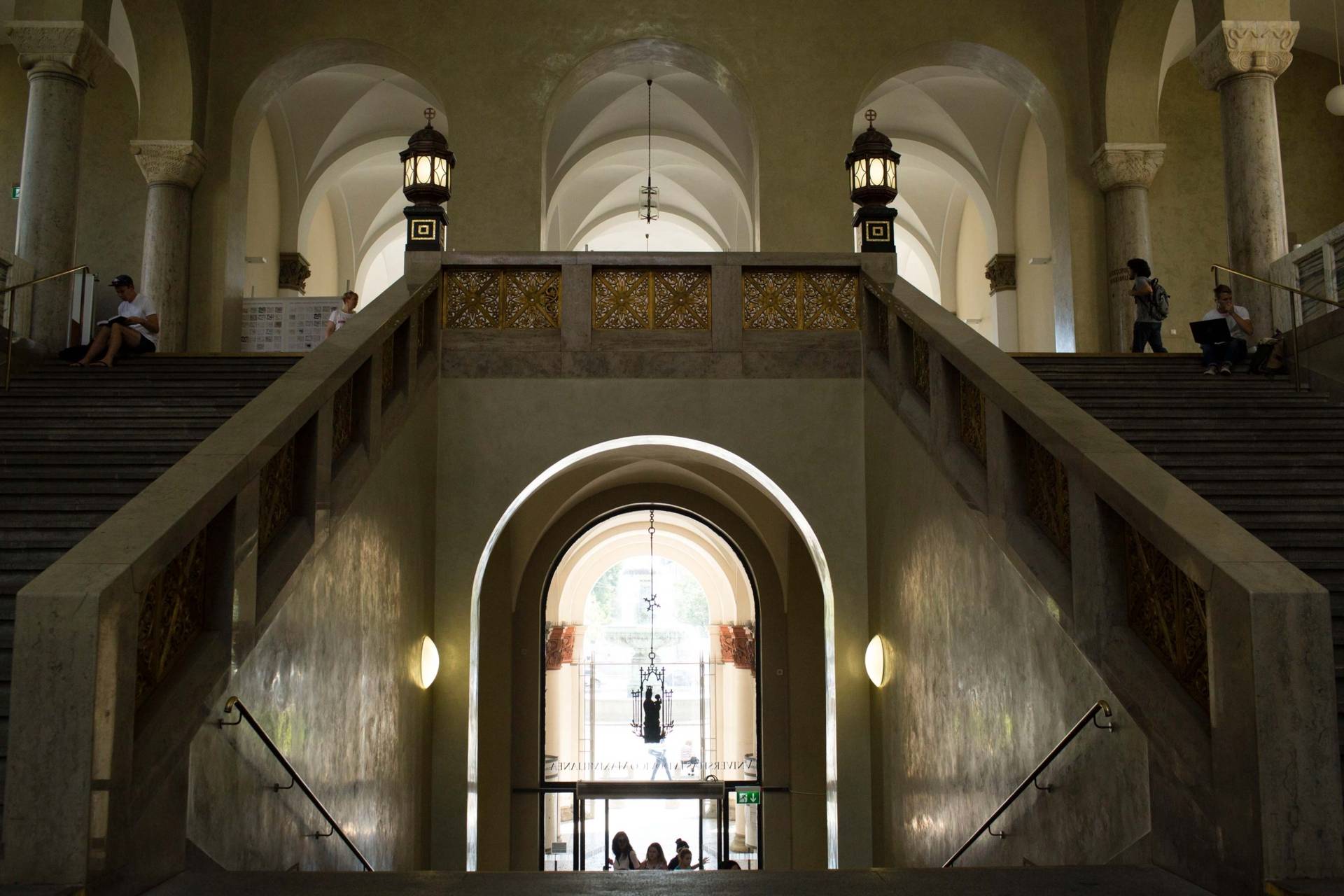
Geschwister-Scholl-Platz forms the impressive entrance to LMU and is far more than just a university forecourt. It commemorates Hans and Sophie Scholl, the best-known members of the Weiße Rose resistance group, who stood up for freedom and humanity with extraordinary courage. The wide steps of the main building and the fountain are a popular meeting place for students, staff and visitors. Especially on sunny days, many people gather here to study, chat and simply enjoy the atmosphere. At the same time, the impressive architecture of the main building invites visitors to discover the university’s long tradition and its significance as a place of learning, research and social exchange.
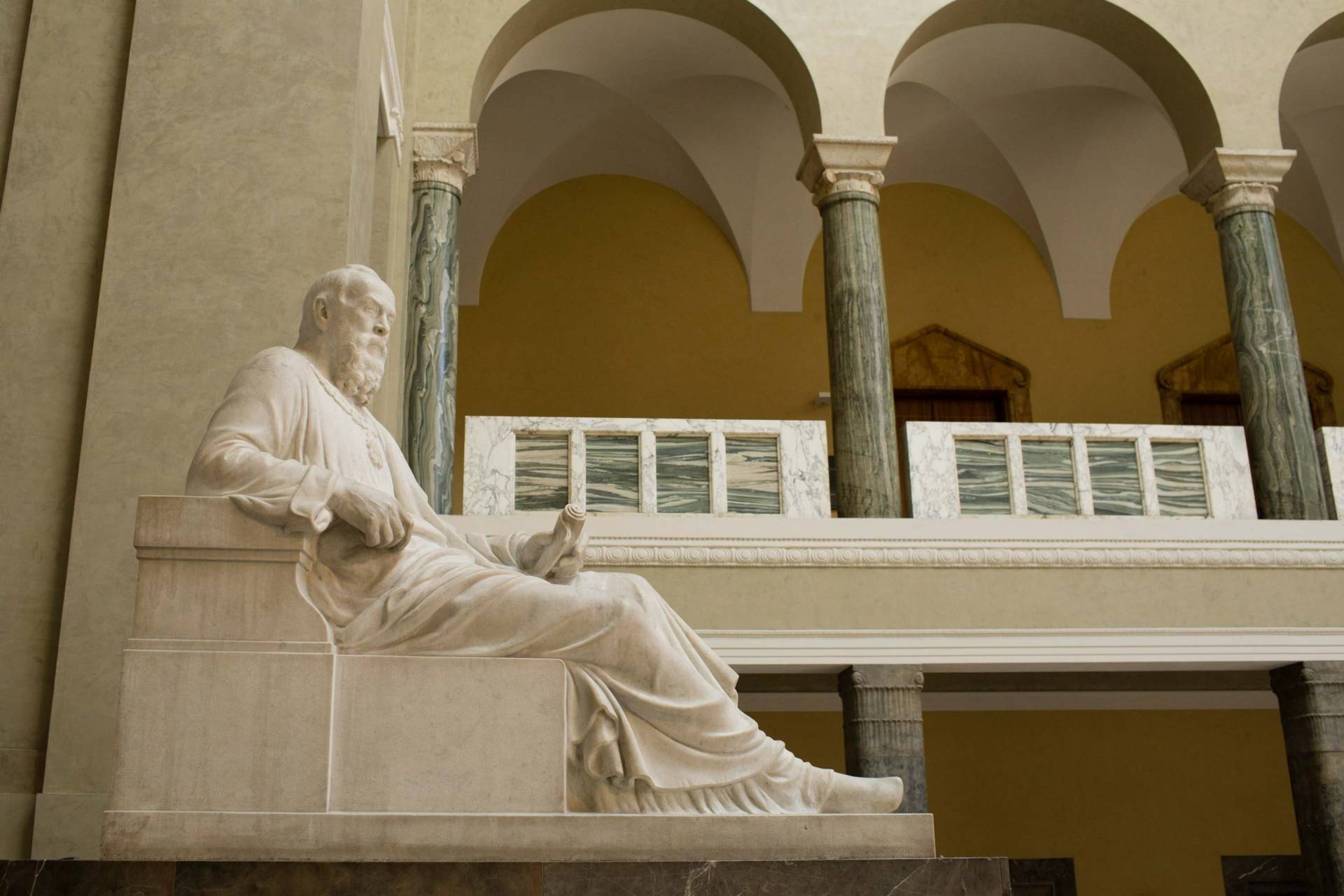
After just a few steps inside the main building, the “Lichthof” opens up – a large, light-filled atrium and the architectural centrepiece of the building. Among other features, it contains the monumental grand staircase with the two seated statues of King Ludwig I and Prince Regent Luitpold, which define the space, as well as the glass dome that floods the atrium with daylight. At the edge of the Lichthof is the DenkStätte Weiße Rose (White Rose Memorial): The exhibition commemorates the Scholl siblings and presents leaflets, documents and the history of the student resistance against the Nazi regime. Near the entrance to the DenkStätte stands a bust of Sophie Scholl, usually adorned with a rose. A commemorative plaque bearing the seven names of the resistance group marks the exact spot on the upper gallery in the atrium from which Hans and Sophie Scholl threw leaflets into the atrium on 18 February 1943. From the first or second floor, visitors can also get the best view of the decorative floor mosaics made of coloured natural stone in the entrance and atrium areas, which can otherwise easily go unnoticed. The floor mosaics consist of geometric patterns and frame the pathways through the atrium.