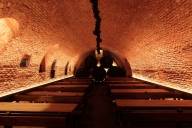
Once indispensable, now largely forgotten: There were around 60 beer cellars beneath Munich, some of which were enormous. What do these underground remains tell us about Munich's rise to become the world capital of beer?
In January 2014, an accident occurred in Haidhausen (district). A 62-year-old Munich resident fell through the pavement on his way back from the Hofbräukeller. He dropped down into a manhole, which, at around 70 by 90 centimetres, was not particularly large. Fortunately, the man escaped with only minor injuries. Still, he had a terrible fright, as the shaft was at least six metres deep. It soon became clear that it belonged to one of the beer cellars of Faberbräu, one of Munich's oldest breweries, founded in 1397 and in operation until 1920. Three of its cellars were situated close together along the northern side of Innere Wiener Strasse and were built in the first half of the 19th century. In the late 1980s, the remaining beer cellars were filled in to make way for new construction projects. Only the ventilation shaft remained. After the accident, it was permanently and securely sealed.
Beer cellars? That sounds like quaint vaulted cellars where people sit happily late into the night in a haze scented with beer. But that would be a decidedly modern way of thinking. In reality, beer cellars were once indispensable for producing the beer we know and love today. And since Munich aspired to become the world capital of beer in the 18th century, there was an exceptionally large number of them. At their peak, there were more than 60 beer cellars, built between 1748 and the mid-19th century. They were clustered in two areas that today lie within the city limits: in the east around the Gasteig (cultural centre), along Innere Wiener Strasse, Preysingstrasse and Rosenheimer Strasse and in the west along Schwanthalerhöhe. They all lay close together: a city beneath the city.
Until the late 15th century, Munich brewed top-fermented beer – a cloudy, highly perishable drink to which brewers added all manner of ingredients to preserve it: aromatic herbs, ox gall, pitch, ash and, in exceptional cases, the more daring used henbane, whose hallucinogenic alkaloids dangerously blur the line between intoxication and death. From 1485 onwards, a new method – bottom-fermentation – gradually made its way into Bavaria from Bohemia, Franconia and the Upper Palatinate, all regions blessed with cool rock cellars. After fermentation, the yeast settles at the bottom of the vat, resulting in a beer with a significantly longer shelf life. The problem: It requires constant cold – during fermentation, during the subsequent storage period and, in the case of Märzen beer, for months on end until the new brewing season in autumn. If the temperature were to rise above 13 degrees, the beer would turn sour.
In reality, beer cellars were once indispensable for producing the beer we know and love today. And since Munich aspired to become the world capital of beer in the 18th century, there was an exceptionally large number of them.
The coveted bottom-fermentation method therefore initially took hold in places where nature provided free cooling: In the Upper Palatinate with its cool rock cellars, in Bad Tölz, where natural tuff caves maintained temperatures below six degrees all year round, in Pilsen and Bohemia. Munich was not blessed with these prerequisites. The city centre stood on permeable gravel, the groundwater level was high and the cellars were shallow. In summer, they warmed up and the beer turned sour. For decades, Munich's breweries were forced to buy beer from elsewhere – mainly from Tölz, whose brewers took full advantage of their colleagues' predicament and delivered their beer down Isar river on rafts. It was for this reason that Tölz became known as “Munich's beer wet nurse”.
But whatever those infamous people from Tölz had – deep, cold caves – surely had to be possible in Munich as well. From 1748 onwards, Munich's brewers began digging deep into the ground outside the city walls, into the gravel layers beneath the Gasteig and Schwanthalerhöhe – by order of the Elector, who bluntly instructed the brewers to simply create suitable storage spaces themselves. The result was an underground infrastructure of remarkable dimensions: vaulted brick cellars, up to 13 metres deep, with walls up to a metre thick, ventilation shafts, insulating layers of cork waste and peat moss and ingenious three-door airlocks designed to keep warm summer air away from the precious contents. Astrid Assél and Christian Huber have systematically reconstructed this almost entirely forgotten chapter for the first time in their book “Münchens vergessene Kellerstadt” (Munich's Forgotten Cellar City) (Friedrich Pustet, 2016), describing the result as follows: “One can therefore quite rightly speak of a self-contained, interconnected ‘cellar city’ at the Gasteig.”
In winter, the cellars cooled themselves naturally through open ventilation shafts – the heavier cold air sank down into the vaults, freezing them through. In summer, all openings were tightly sealed, sometimes even bricked up. In the long run, this alone was not enough. So, from around 1830, brewers began to store natural ice. The demand was enormous: A large Munich brewery required up to half a million hundredweight of ice per year, harvested from frozen lakes in the surrounding countryside or, in winters with little ice, brought in from far away. Even King Ludwig II engaged in satisfying Munich breweries' craving for ice: The ice-covered sections of the Nymphenburg Canal were put to auction, with the Obersthofmarschall's office stipulating explicitly in the contract that workers and carts were to be kept out of His Majesty's sight should appear.
At the heyday of the “Kellerstadt” era, around the mid-19th century, almost all 54 of Munich bourgeois breweries had their own storage cellar, most of them even had several. The total output of Munich's breweries stood at around 300,000 hectolitres per year in 1850 and rose to well over one million by the turn of the century. The final – and largest – cellar project of this era was commissioned by Joseph Pschorr on the site of the former Munich Galgenberg, the execution grounds at today's Schwanthalerhöhe. Pschorr had acquired the property at auction in 1809, immediately after the dissolution of the high court and, after ten years of construction, built Germany's largest storage cellar there: 4,880 square metres in floor area, 13 metres deep, popularly known simply as the ‘Beer Fortress’.
A large Munich brewery required up to half a million hundredweight of ice per year, harvested from frozen lakes in the surrounding countryside or, in winters with little ice, brought in from far away. Even King Ludwig II engaged in satisfying Munich breweries' craving for ice: The ice-covered sections of the Nymphenburg Canal were put to auction.
But the days of the cellar city were numbered. In 1873, Carl Linde, a professor at the Technical University of Munich – the very city where the problem was most pressing – developed the first working refrigeration machine and installed the prototype at the Spaten brewery. The first machine exploded, but the second was ammonia-powered and worked. In the decades that followed, the remaining Munich breweries gradually made the switch – hesitantly at first. The Unionsbräu brewery was one of the last to change to mechanical cooling. Today, the technology in every fridge and air-conditioning system is based on Carl Linde's invention.
Of the more than 60 cellars, virtually all have now disappeared. Some were simply built over – the vaults remained beneath the new buildings, enclosed, inaccessible, untouched. Others, such as the Faberbräu cellars on Innere Wiener Strasse, were integrated into new foundations as part of the excavation shoring. The rest were deliberately filled in – with earth, rubble and finally concrete. During the construction of the Gasteig cultural centre in the late 1970s, workers unexpectedly came across several storage cellars and filled them with thousands of cubic metres of concrete before anyone even thought to document them.
Of the more than 60 cellars, virtually all have now disappeared. Some were simply built over – the vaults remained beneath the new buildings, enclosed, inaccessible, untouched.
Whoever wishes to venture into the underworld today, has a few options. At the Augustiner-Keller on Arnulfstrasse, the vaults have been open to the public as a dining area since 2000 – the only place where the cellar architecture has been fully preserved and can still be experienced. At Einsteinstrasse 42 in Haidhausen, the Unionsbrauerei has found a successor: Since 1998, the more than 2,000-square-metre brick vaults of the former storage cellar have been home to the Unterfahrt – one of Germany's most renowned jazz clubs. And at Innere Wiener Strasse 4–8, less than 200 metres from the scene of the pedestrian accident mentioned at the start, several steps lead down into the renovated vaults of the former cellars of Thor, Unterkandler and Büchlbräu – today a bar, eight metres below ground, with brick arches and a consistently cool temperature.
The true legacy of Munich's cellar city, however, remains visible to this day – even if few people realise that it has anything to do with the beer cellars. To keep these cellars cool even in the summer heat, they had to be shaded. For that purpose, brewers turned to a tree that had been imported from the shady forests of the southern Balkans from the 17th century onwards: the chestnut. Not only does it grow quickly and form a dense canopy, but it also has a shallow root system that does not damage the brick vaults beneath the ground.
Whoever wishes to venture into the underworld today, has a few options. At the Augustiner-Keller on Arnulfstrasse, the vaults have been open to the public as a dining area since 2000 – the only place where the cellar architecture has been fully preserved and can still be experienced.
By 1811 at the latest – a year that went down in history for its brutally hot summer – the people of Munich flocked in droves to the grounds above the beer cellars. There they found not only shade, but also extra-cold beer, thanks to the very short distance it had to travel from the cellar to the table. And this is how Munich's beer gardens were born. Many of the largest beer gardens that still exist today – the Augustiner-Keller on Arnulfstrasse, the Löwenbräukeller on Nymphenburger Strasse, the Hofbräukeller on Wiener Platz – were planted directly above beer cellars. So, if you find yourself sitting under a chestnut tree today, holding a beer mug in your hand and gazing up into the canopy of leaves above you, you are sitting on nothing less than the very lid of Munich's beer history.