Longing for Munich or wanting to recognise your own city, perhaps even your own neighbourhood, while flickering on the couch? These programmes show how you can bring a nice dose of Munich spirit home with films and series worth seeing in the media libraries and on YouTube.
- Fast wia im richtigen Leben
- Pumuckl
- Irgendwie und sowieso
- Kir Royal
- Die Löwengrube
- München Mord
- Servus Baby
- Fett und Fett
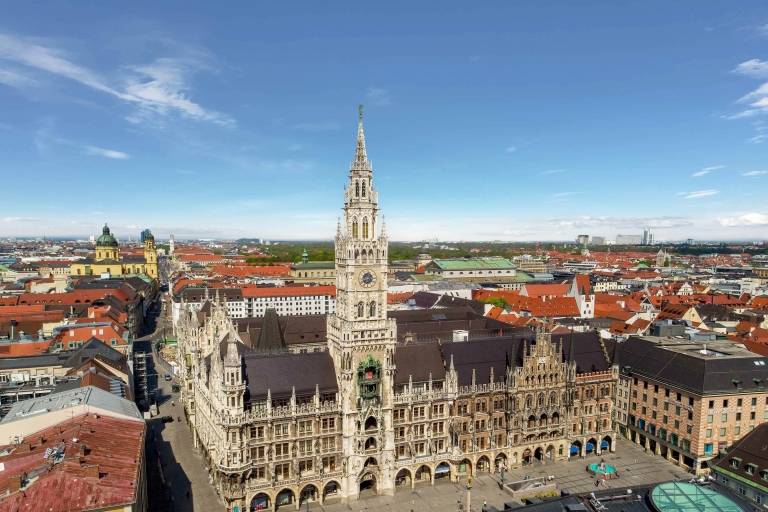
- Münchens schönste Plätze
- Oktoberfest 1900 und Oktoberfest 1905
- München Beats
Have you heard? BR is repeating all the episodes of this series in sketch form; winner of the Adolf-Grimme award, it shows the Bavarian satirist Gerhard Polt at his most perceptive and thus at his best. In this satirical classic, Polt makes fun of the nouveau riche and the bourgeois and critically comments on still current topics such as gentrification and xenophobia. Together with his equally funny partner Gisela Schneeberger, Polt takes a dig at the paradoxes of everyday life – and the nastiness of his fellow citizens. “Fast wia im richtigen Leben“ (Almost like real life) is without a doubt hilarious, even if your laughter gets stuck in your throat sometimes. Plus, the guest roles are played by a who's who of Bavaria's stars of the early 80s, including Helmut Fischer, Ruth Drexel and Hans Brenner.
The red-headed goblin could well be Munich's most prominent Münchner Kindl (Munich child) – he's certainly the city's craziest. When you hear Pumuckl speak as an adult, you vacillate between astonishment and a wry smile. His newly made-up words and repetitions, his grating voice (spoken by dubbing legend Hans Clarin) and his rhyming orgies are a real challenge – for the audience, but above all for Pumuckl's stoic foster father Master Eder. Children of course love the cheeky goblin, because he is always up to pranks and maintains his extremely good humour. Adults watching the series, however, sometimes wonder what stimulant the red-headed gnome has been given. Pumuckl is a cult, and Master Eder is the prototype of the warm and welcoming typical Bavarian who is not ruffled by anything and who speaks such a beautiful Munich dialect rarely heard in the city today. Right down to the smallest supporting role and the set (women in traditional aprons, geraniums on the balconies), this series paints a nostalgic and peaceful picture of an easy-going Munich in the 80s, which is lovingly remembered for 25 minutes.
The fact that Pumuckl has lost none of his appeal is demonstrated by the ‘New Stories of Pumuckl’: since 2023, the goblin has been embarking on new adventures in modern-day Munich, and with Florian Brückner as the new Master Eder, he has also reached a new generation. Thus, Pumuckl remains a Munich cult figure – just no longer exclusively in the good old workshop of yesteryear.
The cult series from the 1980s by Franz Xaver Bogner with the soundtrack of the 1960s shows how the wild '68ers make their way into a fictitious village near Ebersberg in the Munich area. The young farmer Alfons Kerschbaumer, known to everyone as Sir Quickly because of his motorbike, an NSU “Quickly“, rebels against the structures on the Kerschbaumer farm and sets off on a journey with his four loyal friends after a heated argument with his father. After various adventures, including one in the Landeshauptstadt München, and a total of twelve episodes, Quickly finally returns to his parents' farm with increased self-confidence. The young Ottfried Fischer became famous as an actor in the role of Sir Quickly. Other leading actors were Elmar Wepper, Robert Giggenbach, Olivia Pascal and Toni Berger. The theme music for the series was composed by Haindling.
“Wer reinkommt, ist drin“ (Whoever comes in, is in) – this is not only the name of the first episode of this six-part series by directing legend Helmut Dietl, it is also the work ethic of the tabloid reporter Baby Schimmerlos. Never before or since has Munich's smart set been captured so authentically on film. Particularly unforgettable is the guest appearance by Mario Adorf in episode 1, playing an egotistical managing director seeking to buy the tabloid reporter's loyalty with money. (Quote: “Ich scheiß dich so was von zu mit meinem Geld, dass du keine ruhige Minute mehr hast.“ (“I'll do all that shit to you with my money until you don't have a moment's peace.“). Much of “Kir Royal“ is pure Munich: from the music composed by Konstantin Wecker to the starring role played by Franz Xaver Kroetz who was born in the state capital – and the countless shots of the Bayerischer Hof (Bavarian courtyard), the Friedensengel (Angel of Peace) and the Bavaria (statue). But most of all Dietl shows, as he did in his other cult series “Monaco Franze“ (all episodes are currently available on YouTube by the way), that comedy and tragedy are often very closely related and that the best insult is often the most honest.
In the past, the Munich police headquarters in Munich's historic city centre was known to citizens as the “Löwengrube“. Today, the official address is Ettstrasse 2 and the large green building just around the corner from the Frauenkirche was and still is the filming location for numerous police series, from “Münchner Tatort“ to “München 7“, from “Monaco Franze“ to “Die Löwengrube“. In 32 episodes, the latter shows the fate of three Munich families – the Grandauers, the Soleders and the Kreitmeiers – over generations from the end of the 19th century to the 1950s. It is both a family series and a crime series, as the fathers in the Grandauers family, first Ludwig and later his son Karl, work for the police. The major political upheavals of the time, not least the two world wars, determine everyday life both at the police station and in the private lives of these Munich petty bourgeois.
Numerous historical figures appear as marginal characters, including the former mayor of Munich Karl Scharnagl, Heinrich Himmler as a pupil; Adolf Hitler, who is arrested as a putschist and taken to the ‘lion's den’; Rosa Luxemburg, who gives a speech in Munich; the Nazi resistance fighter Father Rupert Mayer as a prisoner. Georg Elser's attempted assassination of Hitler is even the subject of an entire episode. The series was honoured with the Grimme Gold Award in 1992.
The most successful detectives often have the ugliest offices, usually in the cellar of an already faceless police station. This is the case with Jussi Adler Olsen's well-known thriller series about the special investigator Carl Mørck and it is also the case with “München Mord (Munich Murder)“. The underground rooms are shared by a trio consisting of the quirky and somewhat outdated detective chief inspector Ludwig Schaller, the police officer Harald Neuhauser, who is not exactly plagued by self-doubt, and his rookie colleague Angelika Flierl, who is rumoured to have only got the job in the homicide department through “vitamin B“.
While Angelika likes to explain the world to herself and others, is always on the lookout for (male) connections, and often displays a touching awkwardness, Harald tends to play the bad cop and the braggart. Their joint boss Ludwig is the true profiler, who doesn't miss a thing and, when things get exciting, sways his head to the right and left like an Indian and eats yellow sausage wheels straight from the wrapping paper. It always gets really funny when the slick and self-satisfied chief detective Helmut Zangel drops by the cellar to demand the results of the investigation.
Whenever Schaller, Neuhauser and Flierl head out for interviews and research, there is plenty of local Munich colour on offer: From panning shots of Ludwigstrasse and Maximilianstrasse to the Mae-West sculpture in Bogenhausen or Mariahilfplatz in the Au district. In their unmistakable way, the three have already successfully completed 22 episodes of “München Mord“.
“Servus Baby“ loves interpersonal relationships, which are shown in an honest, sometimes overwhelming and often surprisingly warm-hearted way. Munich not only serves as a backdrop here, but also noticeably characterises the plot with its attitude to life and its contrasts. At the centre of the story is Lou, a woman from Munich who is left by her long-term boyfriend after he gets a work colleague pregnant. Heartbroken and with a mother who constantly pressurises her with her wish for a grandchild, Lou dares to return to the turbulent Munich singles circus. The combination of everyday life in Munich, lightness and emotional depth makes “Servus Baby“ particularly worth seeing.
Munich has no shortage of series that capture the city's attitude to life – all the same you get the feeling that not much has changed since Helmut Dietl and his legendary 'Monaco Franze'. It could finally be time for an update: “Fett und Fett“ (Fat and Fat) is the name of the mini series that tells the story of Jaksch. He's in his late twentie, lives from day to day, and “sandelt rum“ as they put it so nicely in Munich wich means something like to be lazy or work very slowly. “Everything is generally OK,“ reckons Jaksch, yet he is always looking for something: for a job, structure, the love of his life – but most evenings he winds up at the Cucurucu bar at the Bahnhofsviertel (station district) with a beer in his hand. The series is set in the summer and charmingly depicts everyday absurdities, and what it feels like to live in Munich as a slightly disoriented person in their late twenties. But “Fett und Fett“ is worth watching whatever your age or gender: because apart from the wonderful shots of Munich, including the Isar river, there's a little bit of Jaksch in every one of us.
This documentary is no dry history of the city, but rather a charming stroll to the parts of Munich the two film-makers love most. It's packed with all sorts of details and information, but most importantly you can start to make a list in your head of the places you want to visit first once you come to visit Munich.
The story of the bitter feud between the Franconian brewer Curt Prank and the Hoflinger family, owners of a small traditional Munich brewery, is told in two seasons with a total of 10 episodes up to the year 1905. Based on a true historical event, the first six episodes of the series show Prank on his way to realising his ambitious plan: to build a beer castle for 6,000 guests at the Oktoberfest. Anyone who stands in the way of his dream is pushed aside, bribed or blackmailed. His daughter Clara's love affair with Hoflinger's son Roman comes at the worst possible time for Prank and threatens to break up again and again amidst all the hatred. The dark, dreamlike to traumatic images with which the filmmakers conjure up the Munich and the Oktoberfest of yesteryear send shivers down the spine. But well, it must have been rough and inhospitable at times.
At the beginning of the four episodes of “Oktoberfest 1905“, Curt Prank and Roman Hoflinger have made a pact, as a result of which the beer castle becomes a reality and both parties profit from it to the maximum. However, this is far from the end of the power struggle between the two families. The series is attractive because of the historical Munich references with a true background. Famous institutions such as the Hotel Deutsche Eiche or representatives of Munich's cultural scene and bohemians on the threshold of the 20th century, such as Franziska zu Reventlow or Thomas Mann, also appear in the programme. The two seasons also feature a high-calibre cast with actors such as Mišel Matičević, Martina Gedeck, Brigitte Hobmeier and Maximilian Brückner and up-and-coming actors such as Klaus Steinbacher and Mercedes Müller. The series is attractive because of the historical Munich references with a true background. Famous representatives of the Munich cultural scene and bohemians on the threshold of the 20th century, such as Franziska zu Reventlow and Thomas Mann, also appear in the plot. The two seasons also feature a high-calibre cast with actors such as Mišel Matičević, Martina Gedeck, Brigitte Hobmeier and Maximilian Brückner and up-and-coming actors such as Klaus Steinbacher and Mercedes Müller.
Munich in 1996: the city is in a state of upheaval, techno is taking over the nightlife, and on the former Pfanni site at Ostbahnhof, the Kunstpark Ost is emerging as a new hub for club and subculture. Right at the heart of it all is 19-year-old Linda, who grew up on her parents’ farm in Ismaning. When she comes into contact with Munich’s techno scene, a whole new world opens up for her. Linda moves to Munich to become a DJ. There, she also reunites with her childhood sweetheart Marius, the son of entrepreneur Theo Meinhardt. The ZDF series ‘München Beats’ intertwines the fictional story of two families with a special chapter in Munich’s city history. Whilst the Meinhardts’ traditional family business is on the brink of collapse – threatening the livelihoods of potato farmers in the region – Marius dreams of raves and alternative art and cultural projects on the old factory site. Venues such as the Deutsche Eiche and the legendary Club Ultraschall offer a glimpse into the spirit of the 1990s – a mix of techno, new spaces for the queer scene, family conflicts and the desire for individual freedom.