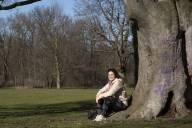
Life as a competitive athlete is full of sacrifices. Enduring the rigours of daily training is a constant mental balancing act. Local Love Ambassador and professional trail runner Kimi Schreiber talks about the places in the city that give her the strength for her seemingly endless runs.
At Lost Weekend, a trendy student café right next to Ludwig-Maximilians-Universität, every seat is taken. It doesn't look as though that's about to change any time soon. Those who have made themselves comfortable at tables and in the seating areas with books or laptops are too engrossed. Kimi Schreiber doesn't mind. After all, that's exactly why she loves this place. “Everyone's working here. And nobody's annoyed by it,” she says. She likes to immerse herself in this atmosphere, letting herself be infected by the feeling of productivity and creativity.
The Lost Weekend also reminds her of her time in Bamberg, where she studied communication studies. “During study periods, going to the café was always a little highlight of the day,” she says. In the meantime, a high table has become free, and she is now sitting there sipping a cappuccino with oat milk as she talks. A touch of nostalgia can be heard in her voice. Sitting in a café, reading, writing, thinking – there isn't much time for that in her tightly scheduled life anymore.
Schreiber is a professional trail runner who regularly finishes in the top places in major mountain races covering well over 40 kilometres. This success demands an enormous training workload – and forms the basis of her livelihood. At the same time, in trail running, winning races alone is not enough to make a living. Visibility to sponsors is at least as important. For this reason, her social media presence plays a vital role for Kimi Schreiber. “At the same time, it's the part of my job I like the least,” she says. But she masters it with ease, which is probably also down to the fact that she has some experience in the field. After completing her studies, she worked in marketing, wrote for a newspaper and undertook internships in film and television. She has loved writing ever since she was a child.
Today, she co-hosts a weekly podcast about Trailrunning, she has also recently published her first book on the sport and writes a column for a running magazine. So taking a ‘Lost Weekend’ to come up with stories or plan topics would suit her down to the ground. “But mostly I do everything at the same time,” she says. Listening to and sharing the latest podcast episode whilst she's running. Thinking about a blog post whilst she's warming up. “Because I train at the weekend too, I'm actually always working,” she says. That's why she seems to enjoy having the chance to soak up some student vibes at Lost Weekend all the more.
“I'm one of the few people in my team who lives in a big city.”
On the way to the Englischer Garten – the second place Kimi Schreiber wants to show us – the cheerful atmosphere continues. It is a warm and pleasant day, the first of the year, and half of Munich is out and about to welcome the approaching spring. We enter the sprawling park via Königinstrasse, cross the Schwabinger Bach and head towards the Monopteros. On the way up, we overtake two ladies who are a bit out of breath. Despite the climb, there is no change whatsoever in Kimi Schreiber's flow of conversation or breathing rate. Places like the Monopteros, she says, she would tend to avoid when training. Too many people. “The three metres of elevation gain aren't worth it,” she says – fortunately out of earshot of the two ladies, who might well perceive Kimi Schreiber's hyperbolic downplaying of the Monopteros (in fact, the hill on which it stands is fifteen metres high) as a slight on their performance. What connects her to the Englischer Garten? “The countless laps and hours I've run here,” she says. Before she lived near the Isar, she mainly trained here.
“I'm one of the only people in my team who lives in a big city,” she says. What do her colleagues at the training base in Munich tend to underestimate? “All of this,” she says with a grin, sweeping her arm towards the vast meadows and the city skyline beyond. But above all, the chance to step away from the world of competitive sport every now and then. “It's entirely down to the individual whether you need that or not,” she says. “I know plenty of people who are happy just doing sport. But I absolutely need it.” We start our descent, making our way towards Odeonsplatz, from where we'll head to the Viktualienmarkt.
Before long, we have left the lush green lawn, the winding gravel paths and the babbling Schwabinger Bach behind us and entered the Hofgarten. The Italian-style Renaissance garden, with its long colonnades, is the very embodiment of dolce far niente. People who look as though they've just popped out for a quick lunch break are playing boules in the shade of the trees. One moment we were at the scene of countless gruelling training sessions for Kimi Schreiber; just a few moments later, we find ourselves in a place where the Munich soul hangs loosely like a ripe chestnut in late summer. A transition that is as fluid as it is radical. The sort of contrast that Kimi Schreiber loves so much about Munich.
“All of this,” she says with a grin, sweeping her arm towards the vast meadows and the city skyline beyond. But above all, it's the chance to step away from the world of competitive sport every now and then. “Whether you need that or not is entirely down to the individual,” she says. “I know plenty of people who are perfectly happy just doing sport. But I absolutely need it.”
Kimi Schreiber was born in Starnberg, south of Munich, and spent her youth in Herrsching on Ammersee (lake). But she became a true Munich resident at Geneva Airport. “I remember it clearly,” she says. At the time, she was living in Chamonix to make the most of the excellent facilities available to trail runners. She was waiting at the gate for her flight to Frankfurt, from where she was due to fly on to South Africa for a race. The gate next door displayed the flight to Munich. “It broke my heart not to be allowed to board that plane,” she says. And that's when she knew: Chamonix had been the wrong decision. Her home is Munich. Could the delicious Leberkäs sandwiches from the Viktualienmarkt have played a part in that? Probably not, says Kimi Schreiber. As a professional athlete, that sort of thing isn't on her menu anyway; besides, she eats an almost exclusively vegetarian diet. Cheese, then, she says, as she gazes with a mixture of awe and caution at a pile of stacked cheese wheels standing in front of the Munich Cheese Manufactory's stall. “Someday I'd love to go on a gourmet tour of the Viktualienmarkt,” says Kimi Schreiber. “Spending an hour going from stall to stall and being able to take whatever you fancy.”
Of course, there's good cheese in France too. No, it's really the Munich way of life that has won Kimi Schreiber over. We've picked up a generously filled sandwich from the Marinas Feinkost stall and found a spot to sit by the splashing honey fountain. Actually, Kimi Schreiber wouldn't need to explain herself any further, such is the cosy atmosphere. She does so anyway: “Although it often gets busy here at the market, it always remains cosy,” she says. “It's touristy, but also traditional. Everything and everyone comes together here to linger. I just love being here.”
Nature, diversity, a zest for life – these are the reasons why Kimi Schreiber lives in Munich. And there is one final aspect that plays an important role for her: “Munich is where I have my base, my network,” she says as we wind our way through the alleys of the Old Town to reach our final stop: the Sven Renz workshop on Neuturmstrasse, which, among other things, produces custom-made insoles. For a long time, Schreiber suffered from cramps. “After three or four hours of running uphill, they'd almost always start,” she explains. “I thought it was down to an iron deficiency or poor nutrition,” she says. Then she decided to try custom-made insoles. “That sorted out the cramp issue.” Due to her enormous training workload, she goes through a lot of gear and is here quite often.
Whilst she waits for her insoles to be dyed in her chosen colour, she continues: “A good local infrastructure is worth a lot. In Munich, I have my physiotherapist, my gym and a good network of doctors,” she says. “I know that for any problem I might have, there's someone who can help me.” And Munich's excellent transport links are also an advantage for her. Whilst her colleagues often have to travel to the nearest major city first to catch a train or plane to their competition destination, Kimi Schreiber's journeys begin right in Munich. “I prefer it this way: having the mountain on my doorstep rather than having to drive ages to get anywhere else.”
Sven Renz pops his head out of his workshop for a moment, greets Schreiber warmly, and asks about her training and upcoming competitions. His interest seems genuine; he clearly takes pleasure in being able to make a small contribution to supporting Schreiber in her competitions. And Kimi Schreiber, in turn, is delighted that it is not just people like Renz who are backing her, but Munich as a whole.


