In the series “I've never been to ...”, our authors explore places in Munich that they have never visited before – even though they have lived in the city for years, or even their entire lives. This time, our Munich-based author Anika Landsteiner embarks on her very first visit to the Deutsches Theater.
New York's Broadway is very far away from Germany. And so are the London West End shows. Here at home, people often turn their noses up at musicals. Many find them too loud, too colourful and simply overstimulating. In other words: too kitschy for German theatregoers, who are used to Kleist, Goethe and Lessing. I believe that's why I've always been prejudiced when it comes to musicals.
All I knew about the Deutsches Theater was that it is a traditional musical venue. However, I didn't know that this theatre in the lively Bahnhofsviertel district is renowned for its top-class international guest performances. That made me curious. How about a bit of holiday in my own city, a whiff of international theatre atmosphere? When browsing through the programme, I promptly decided on the musical Kinky Boots, performed in Munich for twelve days by the London West End production.
On a dreary Sunday afternoon, I drag myself off the sofa and make my way to the theatre in my not-so kinky winter boots. I'm completely surprised by the large number of people already getting into the mood for the musical in the beautiful courtyard. So much crowding on an afternoon? When I take my seat in the second row of the large auditorium and look around, I realise that the performance is almost sold out.
Kinky Boots tells the story of Charlie Price, who inherits his father's struggling shoe factory and wants to save it with an unusual idea: Together with drag queen Lola, he starts producing extravagant yet high-quality boots for drag performers. The première took place in 2012 in Chicago, with music and lyrics penned by pop icon Cyndi Lauper. From 2013 onwards, the musical was performed on Broadway and received a total of six Tony Awards – the Oscars of American stage shows.
All I knew about the Deutsches Theater was that it is a traditional musical venue. However, I didn't know that this theatre in the lively Bahnhofsviertel district is renowned for its top-class international guest performances.
Right from the start, I am catapulted into Charlie's world, as he despairs at keeping the shoe factory running and then stumbles into a drag show. The high energy on stage sweeps me away completely, because every inch of the stage is alive. To me, this great attention to detail demonstrates the performers' incredible artistry – when so much is happening all at once, it is clear that the foundation is built on a perfect blend of structure, discipline and concentration.
The actor who completely blows me away with his performance is Tosh Wanogho-Maud, playing drag queen Lola. He sings, dances and acts at the highest level, making him a triple threat: a term used to describe performers who excel in all three disciplines. When he sings the ballad “Not my father's son” and I can see the tears running down his cheeks from my seat in the second row, his emotionality truly gets under my skin.
After 60 minutes of play, there is an intermission, which I use to grab a pretzel in the foyer and learn a bit about the theatre. The Deutsches Theater has been Germany's largest guest-performance venue since 1896! It was founded under the artistic direction of Emil Meßthaler, who shaped the theatre with his experimental educational formats. It has two stages – the large theatre hall and the Silber Hall with its adjoining Baroque Hall, where smaller plays, concerts and readings take place. During carnival season, it even transforms into Munich's largest ballroom. A diverse programme has been built up over many years, though it has repeatedly faced setbacks.
I believe that Kinky Boots is a prime example of the musical industry, because it whirls together different art forms to deliver a message to the classical stages: “Now more than ever!”
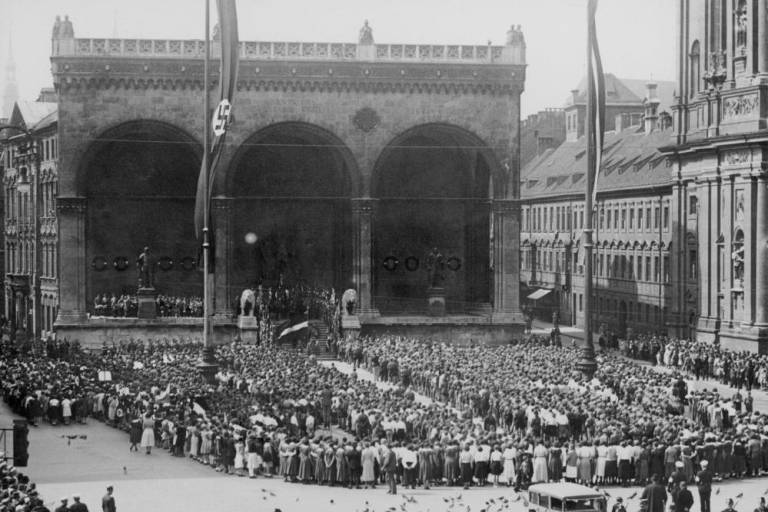
Through performances by Karl Valentin, it became clear how strongly the theatre was culturally rooted in Munich. But at the end of the 1920s, American singer and dancer Josephine Baker was banned from performing, marking the racist agitation that had already begun before the Nazi era. Stage star Baker was mainly known for her extravagant dancing. In the eyes of conservative groups, a half-naked Black showgirl was already the epitome of moral decay.
A little later, in the 1930s, it was no longer allowed to hire Jewish authors, which led to a major rupture in what had once been a vibrant theatre culture. It was only after the end of the war that Munich could re-establish itself as a diverse theatre city with the Deutsches Theater. In 1961, a musical conquered its stage for the first time – none other than West Side Story.
After the intermission, the Kinky Boots cast turn up the energy on stage with full force. The plot reaches its climax when Charlie and Lola have a quarrel and the factory workers lay down their tools. This moment is, of course, essential to telling a traditional hero's tale, which serves as a core element in most musicals. The characters in Kinky Boots grow by stepping out of their comfort zones and beginning to respect other ways of life. Because what was that saying about boots again? “Walk a mile in someone else's shoes if you want to understand them.” Or something along those lines. In Kinky Boots, there is more dancing than walking, but that is exactly why the ending is colourful, spectacular, cheeky and, above all: queer.
With the entire audience rising to their feet in a standing ovation that seems to go on forever, the performers lay out a flag in the colours of the LGBTIQ* community on the stage. In that moment, I am flooded with gratitude for having seen the show. That it is still allowed to be performed, or rather, that it must be performed. What an appeal for an open, empathetic and respectful society! At the same time, I see Kinky Boots as a prime example of the musical industry itself, because it whirls together different art forms to deliver a message to the classical stages: “Now more than ever!”