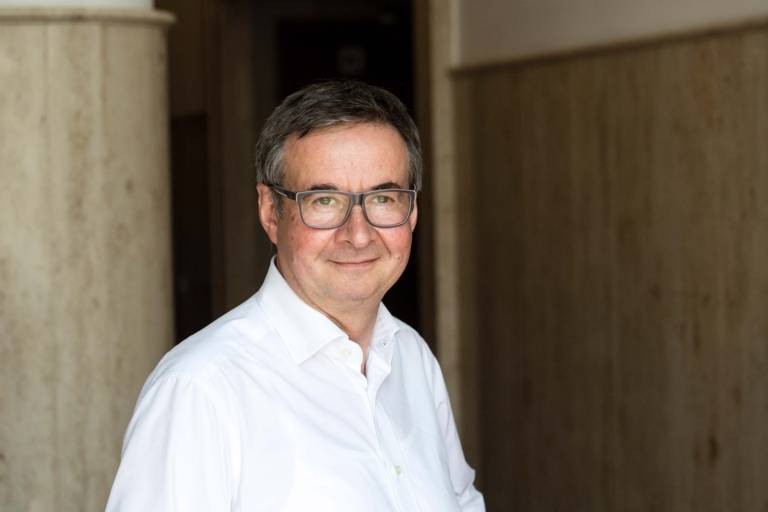
People say that non-alcoholic beer suddenly tastes good. But is that really true? And if so, what has changed? We asked Prof. Dr. Thomas Becker. Holding the Chair of Brewing and Beverage Technology at the Technical University of Munich, he conducts research in Weihenstephan into the present and future of beer – and is not only an expert on the metabolism of wild yeasts, but also on the secret machinery that has opened up a whole new world of flavours for non-alcoholic beer.
Non-alcoholic beer is currently causing quite a stir. This is certainly partly because many people suddenly find they like the taste. Have quality and flavour actually improved?
The first non-alcoholic beers were niche products. The primary aim was simply to produce beer without alcohol. No particular expectations were placed on the production process or the drinking experience. And that's how it tasted for a long time. It is only now, after many years of declining beer and alcohol consumption, that people have really turned to the alcohol-free variant. Instead of viewing it as an afterthought to the conventional brewing process, brewers have developed their own recipes and base beers. I can therefore fully confirm the impression that the quality has improved.
“Base beers”?
There are essentially two ways to produce non-alcoholic beer. One involves preventing alcohol from forming in the first place. To do this, the yeast's fermentation activity is stopped by rapidly cooling the brew. Alternatively, you can first brew a normal beer containing alcohol and then remove the alcohol afterwards. Both methods require a starting product: the so-called base beer. And the composition of this base beer – original wort, hop character, mashing process and so on – has a major influence on the taste of the final non-alcoholic product. That is the main reason why non-alcoholic beers have improved so much.
“The brewers did not take it seriously.”
Put simply, in the past everything was done more or less in the usual way – and only afterwards was fermentation stopped or the alcohol removed.
The brewers did not take it seriously. Their attitude towards alcohol-free beer was basically: “If I have to, I'll just do it.” It is not surprising that this approach did not produce a great result.
Greater care is taken in the production of the base beers ... has anything else changed in the production process?
A great deal of research has been carried out – including here with us. For example, the process for removing alcohol afterwards has advanced considerably. Today, brewers use techniques that are much gentler on the aroma: Vacuum evaporation systems that can be operated at lower temperatures. Condensation separation as a method of recovering aromas. An even more recent development is the use of membrane filter or reverse osmosis systems, which allow alcohol to be removed very selectively. This is a process known from water treatment that works with almost no temperature control. Nanofiltration is used to remove ethanol, which fortunately is a relatively small molecule. A positive side effect of this reduction is that the remaining aroma compounds are actually concentrated. Of course, alcohol is an aroma carrier. As far as the drinking experience is concerned, there will therefore always be a difference. Although we haven't even mentioned another exciting trend yet.
“But I am not allowed to reveal it.”
What trend is that?
Yeast. In conventional brewing, yeast converts sugar into alcohol. However, there are also yeast strains that cannot ferment maltose, the main sugar in the wort. These yeasts ensure fermentation activity and produce carbon dioxide without producing alcohol.
Let's take one beer that is often credited with helping to fuel the current craze: Augustiner-Bräu's non-alcoholic Helles, which still tends to sell out quickly – even years after its launch. Can you tell us which process is used to make it?
Yes. But I am not allowed to reveal it. All I can say is: Here in Weihenstephan, we know Augustiner's non-alcoholic beer very well.
Were the processes you've just described invented here?
They were certainly further developed, refined and researched here. But the greatest advantage that we, the Technical University of Munich have, is something else: we have all of these processes in-house and can apply them side by side to compare them. That is something unique. And it is also the reason why many breweries come to us before launching a new alcohol-free product. I reckon that around 40 breweries have already asked us to share our expertise with them.
Don't breweries conduct their own research?
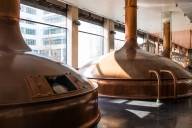
The largest breweries – the global corporations – certainly run their own research centres. But below that level, this quickly becomes challenging. Smaller breweries simply lack the resources. And the large breweries, naturally, operate on a large scale. The problem is that you can't experiment with batches of 50 cubic metres – which means 50,000 litres – of beer. That is precisely where our strength lies here in Weihenstephan. We can work on a much smaller scale: with batches of eight, 80 or 800 litres. And the facilities are designed in such a way that the results can really be scaled up. What works here with eight litres will also work with 50,000. A number of breweries have recognised this challenge and are focusing less on efficiency and more on flexibility by investing in smaller-scale equipment. But you have to be able to afford that.
“The problem is that you can't experiment with batches of 50 cubic metres – which means 50,000 litres – of beer.”
That certainly sounds like a lot of effort.
Indeed. But consumers see it differently. There is a widespread perception that non-alcoholic beer should be cheaper because it contains no alcohol. In reality, the opposite is true. There are more processing steps involved, additional equipment is needed and so on. All of this makes the production of non-alcoholic beer more expensive.
You are quite open about the different methods, tips and tricks involved. It doesn't sound as though brewing a good alcohol-free beer is some great secret.
Ah, then you've misunderstood me. It takes a very long time to develop a good recipe. After all, you probably don't want to brew just any beer. You want to brew your own beer – with its own style, its own identity – and be able to reproduce it consistently. That's a complex process with countless variables. It starts with the choice of raw ingredients and extends right through to the production methods used. Even the answer to the question of the final residual alcohol content has a major influence on the process. Should the beer contain 0.0% alcohol by volume? Or is up to 0.5% ABV acceptable? How do you achieve that? By stopping fermentation? By blending alcohol-free and alcoholic beer? I always tell my students: Brewing a good beer once is not difficult. You try it 500 times and one of those times it works. But if you want to reproduce it consistently and truly understand what you're doing, that's an enormous amount of work.
Can you tell from the label – for example, from the alcohol content – whether the newer, improved methods have been used?
In the case of 0.0% ABV beers, I believe the focus is less on the production method and more on the fundamental positioning of the product. Public awareness of the harmful effects of alcohol, which are often associated with beer, has increased significantly. A ripe banana contains between one and two per cent alcohol by volume. Even cloudy apple juice, left to stand for a day, contains alcohol. However, consumer protection organisations have argued that it is misleading to label beer as alcohol-free if it still contains up to 0.5 percent alcohol by volume. Consequently, breweries felt compelled to offer beers with 0.0 percent alcohol as well. But this rules out certain production methods, like, for example, stopping fermentation through cold-contact techniques, because a small amount of alcohol is still produced. Even wild, non-conventional yeast strains produce a small amount of ethanol. So, the only option left is physical removal after fermentation. However, these beers are often inferior in taste. Brewers then usually try to compensate this with hops, so that the beer does not taste too sweet or watery. In this respect, the alcohol content indeed provides an indication of which production method was used.
Do you have a preference?
As a scientist, I try to set my personal preferences aside. However, I believe that the future does not lie in a single process, but in a combination of several processes: Combining arrested fermentation with dealcoholisation in varying proportions, using different yeast strains and, where appropriate, refining the product using a membrane filtration process. To my knowledge, however, there is no brewery operating in this way yet. It would require investing in several expensive pieces of equipment.
So, in terms of aroma and taste, has non-alcoholic beer not yet reached the end of its development?
No, there is still room for improvement. But breweries are under considerable economic pressure due to declining beer consumption. If you lose five per cent of turnover in the alcoholic sector, this loss cannot be offset by an increase in turnover in the non-alcoholic sector. Even if the growth rates here are in the double digits annually. Because the base is much smaller. Nevertheless, it remains an exciting sector, and we can look forward to interesting results in the coming years. Recently, for example, we produced a non-alcoholic, bottle-fermented wheat beer for the first time. During the tasting, not everyone was able to tell whether it really contained alcohol or not.
“Towards beers that are fresher, more highly attenuated, lighter and more refreshing.”
The German Purity Law permits only four ingredients in beer and is more than 500 years old. Isn't that enough time for one of the world's leading universities – home to the world's oldest academic brewing school – to have fully grasped the subject?
Thankfully, we are still miles away from that! The processes alone – the chemistry, the physics, the biology – are so complex that we are still a long way from understanding everything. From a physical standpoint, there are many things you are allowed to do: boiling, filtering and so on. And the variability of the ingredients is greater than you might think. There are different types of malt – around a hundred of them. Hundreds of varieties of hops and yeast. Water is also often underestimated. Depending on its ionic composition, water can completely alter the taste of beer. From a mathematical point of view, it would be possible to brew several billion different types of beer. Whether one should do so is another question.
Is the beer brewed today different from that brewed 20 years ago?
Yes, if only because consumer preferences have shifted. Away from malty, full-bodied, heavy beers. Towards beers that are fresher, more highly attenuated, lighter and more refreshing. From a technical standpoint, the level of automation – and thus reproducibility – has improved significantly. Temperatures can be set and maintained much more precisely. Brewers are no longer so heavily dependent on the working methods of individual brewmasters. If quality is defined in terms of consistency and reproducibility, it has improved considerably over the last two decades.
When it comes to drinking: How exactly is quality assessed in a research institution like yours? By tasting the beer?
We try to use as many objective measurement methods as possible. But sensory analysis is just as important. And that's not simply a matter of whether you like the taste or not.
So, what is it all about?
It is about an objective sensory evaluation that goes beyond personal preferences and is understandable to others. It requires training. That is why I hold a tasting session every Tuesday using 40 to 50 different aroma compounds. After all, anyone can say whether it ‘tastes good’ or ‘doesn't taste good’. But for an objective evaluation, you have to practise – and keep practising.
“Beer has an identity, is an important part of social life, and it carries an emotional dimension that makes it far more than just another foodstuff.”
So people drink the beer that is brewed here?
Yes, they do. You can even buy it. However, it costs roughly twice as much because it's something quite special. Besides, selling beer isn't our main focus. We do, however, regularly brew speciality beers. Most recently, for example, we brewed an anniversary beer for Siemens.
What does a Siemens beer taste like?
Excellent. Excellent.
That doesn't sound particularly objective.
(laughs) A special brewing process was used, along with a specific variety of hops. The result was a beer that really stands out in this unique combination and has a strong, distinctive character.
One final question. What is good beer to you: Science or art?
Beer has an identity, is an important part of social life, and it carries an emotional dimension that makes it far more than just another foodstuff. Brewing it is an art – and being able to explore the result as a scientist is a tremendous joy.
Curious? Discover the secrets of beer on a beer and brewery tour in the beer capital of the world. Click here to book.