In Munich, beer is a religion. Virtually every Munich resident has an opinion on it – a favourite brewery, pub or beer garden. But the liquid gold shines so brightly and the anticipation of that first sip is so great that it's all too easy to overlook how it actually ends up in the glass. And yet, the way a beer is poured is crucial to the enjoyment. As with all true religions, there are genuine wars of belief here too. For this Beer-Pouring Report, we delved deep into Munich's beer scene – and uncovered the secrets, peculiarities and promises behind the different tapping methods.
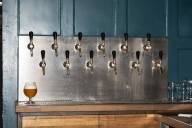
The search for the perfect draught beer begins at Bufet, an unassuming-looking pub near Munich Central Station. Its mission is to introduce a new tapping culture to Munich: tank beer. The technique was invented in the Netherlands, but became popular in the Czech Republic under the name “Tankové pivo”. The revolutionary idea consists of two parts: first of all, it is “fresh beer”. The reason beer nowadays has a shelf life of weeks or even months is that, after brewing, it is pasteurised – briefly heated to 60 degrees Celsius. This is not the case with fresh beer. It has to be drunk quickly, which is hardly a problem – partly because of the taste, which is even smoother and more drinkable than its technically processed counterpart.
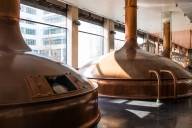
But above all, it comes down to the tapping technique. Bartender Flo explains: “The 500-litre tanks of fresh beer are delivered early in the morning. The beer is contained in a plastic bag inside the tank – imagine a Capri-Sun pouch.” When the beer is tapped, air is forced between the tank wall and the bag, squeezing the bag so that the beer flows out through the tap. This has some decisive advantages. For one thing, the beer never comes into contact with oxygen. For another, it travels barely a meter through the line. But most importantly: It contains only its own natural carbon dioxide. With “normal” draught systems that use added carbon dioxide, some of that gas often dissolves into the beer, causing it to fizz unnaturally. Experts call this “over-carbonation”, and shudder with disgust. At Bufet, however, the beer flows down your throat without the slightest resistance. It feels utterly wrong to stop after just one.
To this day, the myth persists that a pilsner must be poured slowly: The “seven-minute pils” was once considered the gold standard in German pubs. But Stefan Gabányi, owner of the legendary bar that bears his name, has little patience for such old wives' tales. “I recently attended a pouring workshop in Pilsen – after all, that's where it was invented,” he says, as if further proof were needed to underpin his authority on matters of drinks. The defining feature of the Czech tapping method is the ball valve tap. A standard German tap has only two positions: open and closed.
850,000 euros were invested and 15 kilometres of beverage lines laid. Today, the beer is served from special tanks with a capacity of up to 8,000 litres through 40 taps spread across five serving stations.
The ball valve, however, allows for continuous adjustment between these two positions. This enables a much firmer head to be poured, which in the Czech Mléko (“milk”) style can even fill the entire glass. But it's also crucial for an ordinary Pilsner. Gabányi explains: “First I create a small head of foam, then I push through it with the tap and fill the beer from below.” Here too, the CO₂ pressure is decisive. In perfectly calibrated dispensing systems, the pressure is set just high enough to push the beer through the line – without re-carbonating it. The pilsner that Stefan pours in a matter of seconds therefore contains only its own natural fermentation carbonation – the good kind. The “lid” of creamy, dense foam seals it perfectly and prevents harmful contact with the air. And at the end – which comes soon after the first sip – a little of that dense foam still lingers at the bottom of the Czech mug, which is inspired by French bistro pitchers from the turn of the century. Three cheers to Europe, the continent of drinking pleasure.
“So, you're here to drink?” the waitress at the Hofbräuhaus (beer hall) asks us, already clearing the menus from the table. Apparently, the deadly seriousness with which we are conducting our Great Beer-Tap Report is written all over our faces. And indeed, we enter the world’s most famous beer hall with eager anticipation, because the Hofbräuhaus raises an interesting question for our investigation: How does the Hofbräuhaus manage to quench the thirst of up to 35,000 visitors a day? The speed with which our “Helles” appears on the table certainly suggests a sophisticated system. It tastes – and this is meant as a compliment – exactly as you'd expect. Subtly tart, with a hint of citrus acidity, fresh. The foam head is thin and fleeting, though this has less to do with the pouring process than with the beer itself, because the carbonation is distinctly noticeable.
And yet there is no sign of the dreaded “over-carbonation.” The draught system is obviously well calibrated. This impression is later confirmed by further research. In 2019, the Hofbräuhaus completely modernised its draught system. 850,000 euros were invested and 15 kilometres of beverage lines laid. Today, the beer is served from special tanks with a capacity of up to 8,000 litres through 40 taps spread across five serving stations. In addition, there are conventional kegs equipped with an automatic keg-changing system that allows up to three barrels to be tapped per minute. That’s the taste of progress.
The Gasthaus Isarthor (yes, with an “h”) has a reputation in beer circles that's as thunderous as the name suggests – which fits quite well, as Thor is, after all, the god of thunder. Space is tight; with a bit of luck, you might manage to stand at the bar, which is the best spot anyway, because that is where you can watch bartender Vasilije at work. Tapping from a wooden barrel is the most natural method. No artificial pressure is applied – only gravity. Here, too, the beer impresses with its low carbonation – and immense enjoyment. Plus: the beer is colder than what one is used to.
It flows from standard taps at around 7 degrees Celsius. Since a wooden barrel cannot simply be artificially cooled whilst being tapped (the old method of placing ice sticks on the barrel is no longer used), it comes out of the cold storage at just 2 degrees. The low carbonation (of all the beers we've tasted, the one at Isarthor is the least fizzy) does not make the beer taste flat – or “lack”, as they say in Bavaria. Rather, low carbonation and icy an temperature form an ideal balance of pleasure.
On its website, Guinness also states that the pouring process should take “approximately” 119.5 seconds. Such pedantry deserves a toast. We raise a glass to the Bavarian-Irish kinship.
Standing next to us at the bar are two regulars who initially eye us – the obvious novices – somewhat critically. But then, when it comes to concrete questions about pouring and drinking, their wisdom and theories on the subject bubble out of them like beer from a freshly tapped barrel. As we praise Vasilije's skill and the almost unbelievable drinkability of the beer from the wooden barrel, one of them utters a phrase that sounds like a secret message shared among initiates (and for which he is immediately rebuked by the other): “Tapped by God's Hand”.
Do you need to justify drinking Guinness in Munich? Of course not. The city's passion for beer is simply too great for that. So great, in fact, that people are happy to try other brews as well. All the more so when it comes to an interesting beer like Guinness, which is also poured in a very special way. So, we head to Holy Home, a trendy bar on Gärtnerplatz square and one of the only places in Munich with an original Guinness draught system. The young bartender certainly knows how to operate it, as evidenced by the beautifully dark beers, which are poured in two stages (the foam needs to settle in between), with their characteristic creamy (but not too thick!) foam head. But when we try to coax the secrets of Guinness tapping out of him, he refers us to regular guest Irving.
Irving (named after the writer John Irving), in his late 20s, an IT employee from Paris who has been living in Munich since visiting the Oktoberfest four years ago, explains straight away: “I never drink water. Only Guinness.” That's our man. What makes Guinness special, he explains, is the nitrogen. This is not only present in the beer itself, but also in the draught gas, which consists of 75 per cent nitrogen and just 25 per cent carbon dioxide. Nitrogen dissolves in liquids far less readily than carbon dioxide. This results in smaller, finer bubbles, which form a velvety, dense head – and ensure an exceptionally smooth drinking experience. We're told that the bar had to go through a rigorous application process to obtain the Guinness tap system. On its website, Guinness also states that the pouring process should take “approximately” 119.5 seconds. Such pedantry deserves a toast. We raise a glass to the Bavarian-Irish kinship.
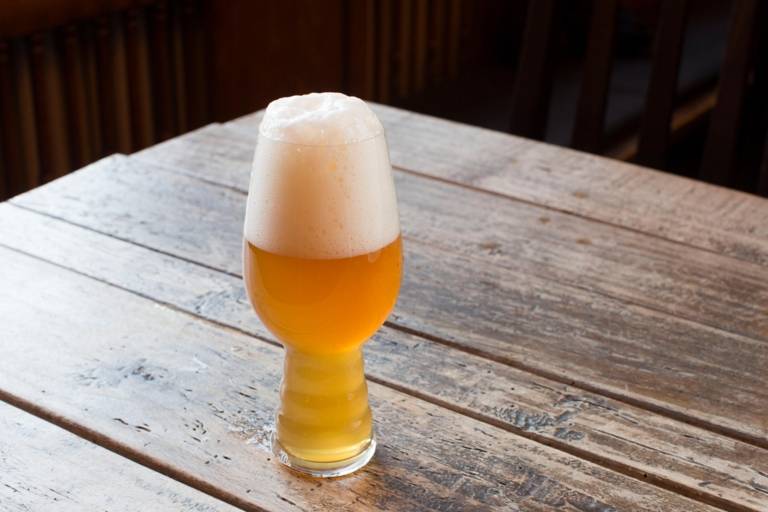
In 2006, two young brewers entered the Munich beer scene with a seemingly impossible mission: to brew a new Munich beer. What began as a start-up soon made its mark and in 2014, Giesinger Bräu opened a large flagship pub on Giesinger Berg. The “Giesinger Erhellung”, brewed here, is a so-called Zwickl beer, which means it is unfiltered – and, what's more, a fresh beer, meaning unpasteurised. That is truly unusual: even Giesinger Bräu's bottled beers are old-school draught beer at heart. Zwickl beer (the name comes from the fact that it was originally tapped directly from the storage tank via the “Zwickel tap” – as a test beer) traditionally has less carbonation than a normal “fully matured” lager. We prick up our ears, as we have learnt so far that low carbonation means high beer enjoyment.
The incredibly appetising-looking ice head floating on top of the Kirin Ichiban gives off an intense citrus aroma. This creates a wonderful harmony with the tart-malty lager beneath. It tastes best when you take big gulps and let the beer and beer-ice-head mix in your mouth.
The main pub, popular with younger men who identify strongly with Giesing (fans of the 1860 football club, the up-and-coming working-class in technical professions), has two serving areas. In the brewery house, the beer flows more or less directly from the storage tanks into the tap system. However, the bar counter of the pub next door is located on the first floor. The beer therefore has to be pumped upwards under considerable pressure. This gives a strongly sparkling drink: fresh, subtly full-bodied – yet its effervescence is more reminiscent of apple spritzer. However, this does nothing to dampen the mood at the long beer tables. People here see themselves as Giesingers – and “Giesinger Erhellung” is the perfect drink to go with it.
Our next stop: The “Brew Pub” BrewsLi in the Au. But that wouldn't be entirely correct, because craft beer is served here. In this case, the English term is not just a modern trend, but a meaningful distinction between the different types of beer offered. The beer is brewed on site by founder and master brewer Ben Saller, in 250-litre batches, with an almost fanatical focus on craftsmanship and precision. How does someone for whom nothing matters more than the highest quality actually serve beer? A question to which Ben has a clear answer: with an open tap. His subsequent mini-lecture on tap systems makes us question the order of our report; perhaps BrewsLi should have been our first stop.
“With the compensator tap used in most tap systems, the pressure is only released at the tap itself,” Ben explains. “To get the beer there, you have to apply extra pressure. That's how you end up with an overly foaming beer.” With an open tap, on the other hand, the pressure is regulated over the length and diameter of the lines. A delicate affair. “But if everything is calculated correctly,” Ben says, “you add exactly as much CO₂ to the beer as it already contains.” And that way, neither the carbonation level nor the quality of the beer is affected. A difference that is highly valued at BrewsLi.
The conversations at the bar revolve almost exclusively around beer. When we are accidentally served an IPA Sour instead of the pilsner we ordered, an observant fellow patron immediately points it out to us. She spotted the difference from several metres away – purely by its colour. In terms of head texture (a lovely, high head) and effervescence (fresh, but not fizzy), the beers are reminiscent of wooden barrel and tank beer, even if the flavour is, of course, completely different. A result that Ben is definitely quite satisfied with.
It's astonishing how the taste of beer changes when it is turned into a sorbet. The incredibly appetising-looking ice head floating on top of the Kirin Ichiban gives off an intense citrus aroma. This creates a wonderful harmony with the tart-malty lager beneath. It tastes best when you take big gulps and let the beer and beer-ice-head mix in your mouth. The other guests at the J-Bar, a small Japanese restaurant in the Isarvorstadt (district), seem to agree. “Almost everyone orders the frozen beer,” says waiter John, sounding slightly surprised. He himself prefers his beer without the frozen head. Still, he can understand its appeal. “In Asia, summers are extremely hot. To make the beer extra refreshing, Kirin invented this machine,” says John. The frozen beer is first poured like a normal beer, but without foam. Then the icy head is added on top. This makes the beer a bit more frizzy, which goes well with the non-carbonated ice.
When we enter the J-Bar, the chances of getting a frozen beer don’t look good at first. Everything's booked – no chance. We plead: just for one beer? But then John is bubbling over with enthusiasm, clearly delighted by our interest. “By the way, Kirin translates as giraffe,” he says, pointing to the dragon-like figure printed on the glass. It depicts a Chinese mythical creature that bears a resemblance to the Bavarian Wolpertinger. In the 15th century, Chinese explorers believed they had discovered a real Kirin in Africa when they came across a giraffe. A sensory confusion that people were only too eager to believe.
John finally asks whether we had tasted the yuzu juice he'd poured over the ice, thereby explaining the citrus flavour described at the start. So we, too, had fallen victim to a taste deception. Beer, it seems, is a master of metamorphosis. It transforms on its journey from the barrel to the glass – and turns taciturn bar staff, stressed bartenders and grim beer drinkers into magnificent storytellers, friendly beer lovers and cheerful fellow human beings.