Our author is a fan of the Münchner Kammerspiele (theatre) and has noticed a promising young actress there whom she would like to introduce: Annika Neugart. During a meet-and-greet, she finds out from Annika how she got into acting, what her dream role is and whether aspiring actresses today still have to be able to play “Gretchen” from Goethe's “Faust”. As a highlight at the end, she is even invited onto the rehearsal stage for a few unforgettable moments.
The call came whilst I was on holiday. Friends asked if they could stay with me in Munich because they had heard an interesting radio feature about a play at the Münchner Kammerspiele. Starring Samuel Koch as Wallenstein. The same Samuel Koch who had an accident on the “Wetten, dass ...?” TV show a few years ago. They also offered to get me a ticket.
When you are on holiday, you always imagine that you will do everything better once you're back. Live more intensely, refuel your spirit. I agreed without thinking twice. Back in Munich, I realised with horror: The play lasts seven hours! SEVEN HOURS OF WALLENSTEIN! I thought: I won't make it through this – as much as I love the theatre, if I have to sit still for that long, I'll end up with Restless Legs Syndrome. Too late – the ticket had been paid for; my friends were already on their way. And, what can I say: It turned out to be one of the most captivating and utterly enthralling theatre experiences I've ever had, and it held me spellbound for all those hours. It was not without reason that this production was invited to the prestigeous 2026 “Berlin Theatertreffen” as one of the ten most remarkable productions in the German-speaking theatre world.
My discovery of the evening was the young actress Annika Neugart, who played the role of Max Piccolomini from Wallenstein's entourage. In the photo, you can see her in the play behind Samuel Koch as Wallenstein, dancing on the tables in a kind of Russian disco scene. It was incredible how she kept up the tension for hours that is written into the role of the young officer – torn between loyalty and a sense of duty, love and the realities of war. Even in the quietest moments, there was still a palpable tension running through her right down to the fingertips. Only to suddenly erupt again with full force at the edge of the stage. From the most delicate subtlety to full-blown stage powerhouse. And thus, she fits perfectly in an ensemble that, by its very nature, gives one hundred per cent and performed so provocatively that evening that the audience – and that's exactly how it should be and which is a good thing – was, at times, slightly overwhelmed, taken aback and even a little embarrassed.
As if that weren't enough, she also sings beautifully – for example as Therese Giehse in “Play Auerbach”, a revue I then went to see a few days later.
She fits perfectly in an ensemble that, by its very nature, gives one hundred per cent and performed so provocatively that evening that the audience – and that's exactly how it should be and which is a good thing – was, at times, slightly overwhelmed, taken aback and even a little embarrassed.
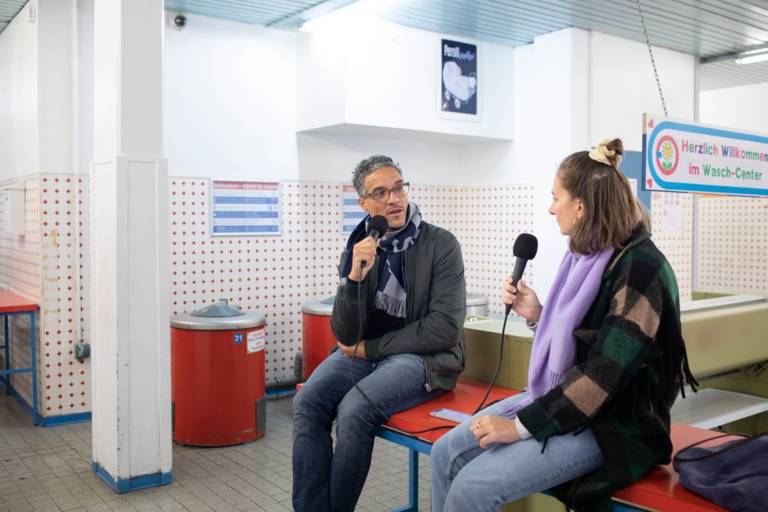
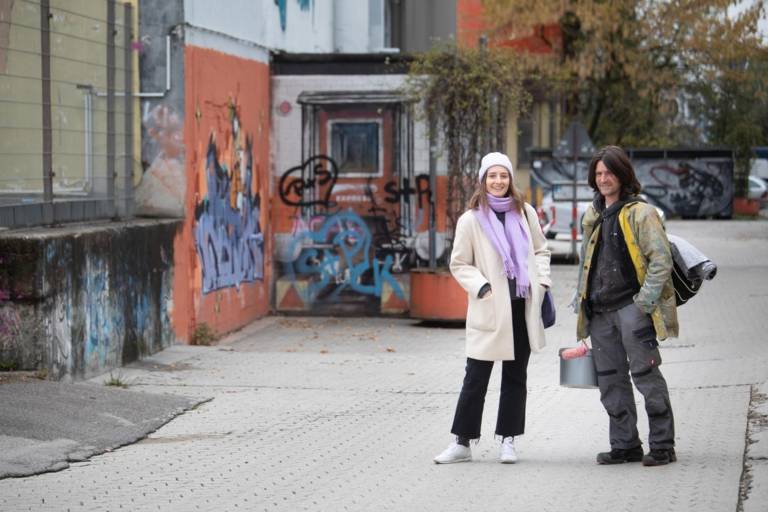
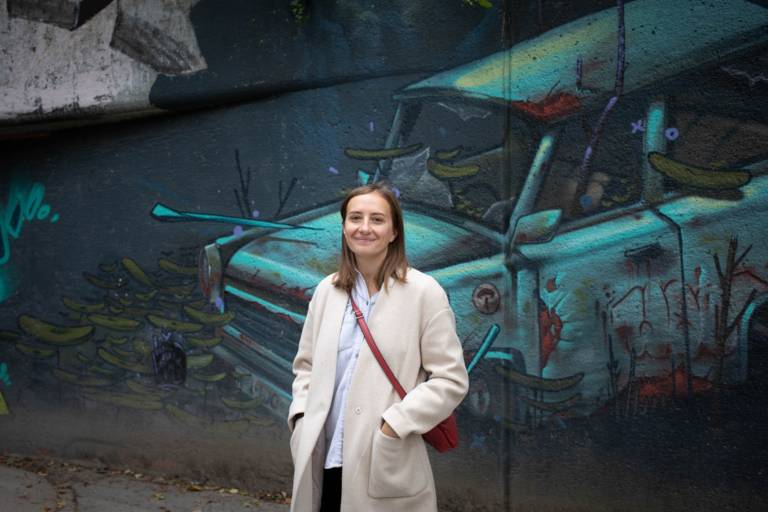
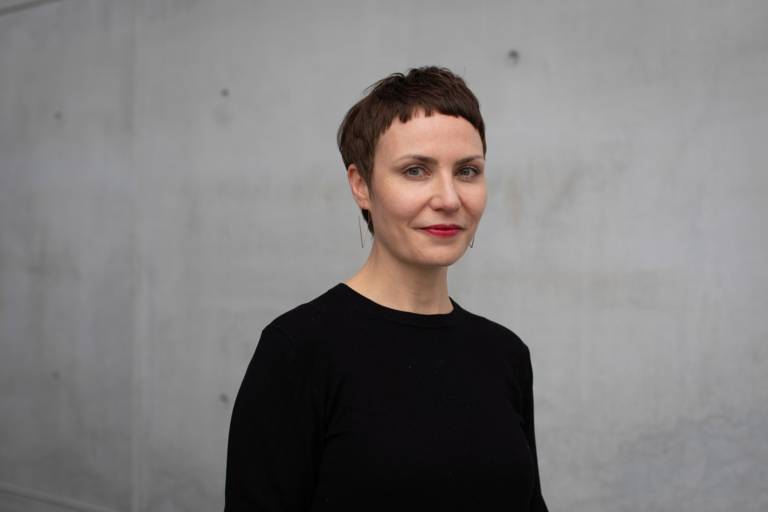
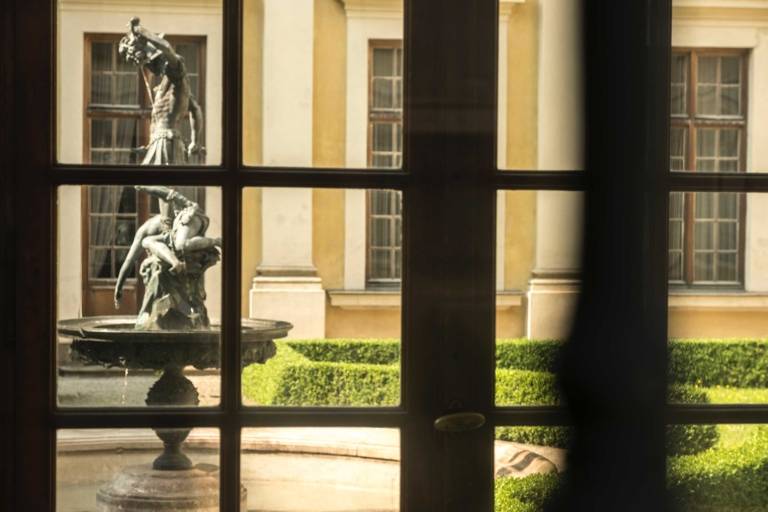
So, I am delighted when she agreed to meet me in the late afternoon in the Kammerspiele canteen – me in a black turtleneck, Annika in Adidas. During the photo shoot in the courtyard, Maxi Schafroth – the cabaret artist and former Lenten preacher at Nockherberg – suddenly rushes up to Annika and declares himself a big fan as well. He says he has already “knocked on her door” several times regarding a possible theatre project together. He is currently directing his improvisation theatre project “Wachse oder Weiche” at the Kammerspiele. A quick fan photo – and he's gone again. We still have about half an hour until rehearsals begin.
Annika's still very young career began in 2020 with an audition at the Otto Falckenberg Drama School. Three different monologues were required, she recalls and she had stumbled into the audition process rather naively. That meant she luckily never really had the chance to get nervous. Now that she is sitting opposite me, she exudes professional calm and confidence. (Totally grounded, I think to myself, quite unlike us back when we were studying drama and everyone was always somehow unhinged, constantly searching for themselves or for a therapy spot.) She quickly picked out the first modern monologue – “some kind of Gaga woman” – from a book of dramatic monologues. The second, which had to be self-written, she hastily drafted on the train to Munich.
The third was a classical piece, which she is still proud of today, while recalling the audition as “actually a bit edgy”. She chose a scene from Shakespeare's comedy “Twelfth Night”, in which the vain and self-righteous steward Malvolio makes a complete fool of himself. He is led to believe that his mistress has taken a liking to him. Eagerly, he follows what he believes to be her instructions and appears smiling, wearing yellow ladies' stockings on his legs, to signal his supposedly reciprocated love. Annika, however, found it more interesting to slip into the role of Maria, the maid, who mimics Malvolio's humiliating appearance to amuse her friends. This must have made quite an impression, because she passed the entrance exam.
When you perform a scene and then want to ask, “How was I?” – but get no response. She, too, struggled with that at times.
Just like – 30 years earlier – Joachim Meyerhoff, an actor and also a Falckenberg graduate, who recounts his ups and downs at drama school in his recently screened coming-of-age novel “Die Lücke, diese entsetzliche Lücke” (the gap, this terrible gap). Annika also notes that life there wasn't always just “all fun and games with amusing assignments”. She thinks, what comes across quite well in the Meyerhoff film is the feeling of being left to yourself, especially at the start of drama school. You're not quite sure what’s expected of you when you perform a scene and then want to ask, “How was I?” – but get no response. She, too, struggled with that at times. Looking back, however, she greatly appreciates that this process helped her develop a highly independent style of acting and supported her in unfolding her own artistic personality.
Did she actually have a plan B back then, in case acting did not work out? “Yes and no,” she ponders briefly, “maybe singing,” but that isn’t really all that different from acting. “That's all I can do and what I really enjoy,” Annika sums up with a laugh.
Naturally, it is probably not always pure enjoyment, but also extremely demanding for everyone involved. Both physically and mentally. How do actors manage to keep their distance from the extreme characters they sometimes have to portray? How do they return to their everyday lives once they leave the stage? How does Annika manage all of this?
“It sounds a bit paradoxical when I say I settle into a kind of calm,” she says, trying to put into words something that is not so easy to explain. “I approach this with composure and always try to treat my characters with great seriousness – not to rationalise them, but to break them down for myself in a way that I can grasp them as real people. After all, I play many characters here with extremely serious issues. When I perform on stage, I take their problems and conflicts so seriously that there is ultimately no other way to play them but in this one very specific way. Then my performance, the style, the whole energy just naturally flows from that.”
For a long time, she had toyed with the idea of moving to Berlin – many of her friends live there – but she now much prefers it here.
And how does she wind down after a marathon like “Wallenstein”? She simply tries to stay as normal as possible. Not to make too much of a fuss about it. Of course, it's sometimes long and exhausting and you are a bit “hyper” afterwards – no question about it – but she thinks it's silly to get carried away or “treating it as if it were some great revelation”. After performances, she often goes for a drink in the theatre canteen. And yes, she usually feels a bit “worn out” the next day.
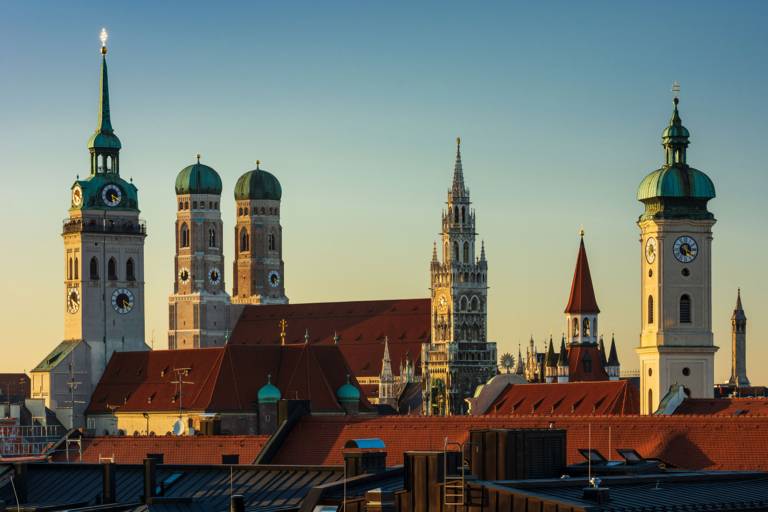
Fortunately, since joining the “Kammer” ensemble, she has had more time and leisure to explore the city of Munich for herself. For a long time, she had toyed with the idea of moving to Berlin – many of her friends live there – but she now much prefers it here. From Bogenhausen, where she lives, she often strolls over to Haidhausen, and she also likes spending time in the Gärtnerplatz and Glockenbachviertel (districts). Every now and then, she – who describes herself as being rather homely – also takes trips outside Munich, for example to Starnberger See (lake) or the Murnauer Moos.
Then I tell Annika a short anecdote from my life. I, too, once planned to apply to drama school and wanted to prepare for it with the help of an older drama teacher who was well-known in our region. So, I plucked up all my courage and arranged to meet her. I rang the bell; she opened the door and invited me in. Still standing in the hallway, she looked me up and down and then said: “My dear child, how on earth do you ever intend to play Gretchen?”
“My dear child, how on earth do you ever intend to play Gretchen?”
“Ah yes, yes, of course! The Gretchen question – the classic one!” Annika bursts out. She keeps hearing from women who've been performing on stage longer than she has that they've been confronted with exactly the same sort of comments. Twenty years ago, that would probably have happened to her too, but as far as her own, still limited, experience goes, thankfully, those times seem to be over. – Really? – Well, things like that have happened to her, too. And she makes her opinion on the matter unmistakably clear: “I find it incredibly boring and I don't want to concern myself with such things, because I believe that people are simply depriving themselves of certain ways of seeing. And I don't care if someone takes issue with my body or my appearance; I find that narrow-minded and embarrassing for those people themselves.”
Annika is open to various kinds of role offers. Whether a character suits her often only becomes clear during rehearsals. Max in “Wallenstein”, for example, she enthuses, has turned out to be an absolute dream role for her. Being naked and covered in slime, as “Glitsch”, another Kammerspiele production, is not something she is particularly keen on. And, she says, that is respected. If she'd ended up in the “slime production”, she certainly would have had the opportunity to say: “Guys, I don't think I can do this.” These are personal boundaries where nobody can simply say: “Well, you'd better take your clothes off now.”
And what kinds of roles suit her best? What would her dream role be? She takes a moment before she answers. Understandably so – after less than a year as a professional stage actress, that is hardly something one can answer off the cuff. “There's probably such a role,” she finally says, “I just haven't discovered it yet.” People often tell her she is particularly convincing when staging strong, tough women. But then she becomes more specific: Medea. Someday, she says, she would love to play Medea. I'm really keeping my fingers crossed that this wish comes true – here in Munich or on another big stage somewhere else. Because that would certainly be a compelling performance: Annika Neugart as Medea.
People are simply depriving themselves of certain ways of seeing. And I don't care if someone takes issue with my body or my appearance; I find that narrow-minded and embarrassing for those people themselves.”
Well, and what about the joint warm-up session at the end? How was I? Happy and content. On the rehearsal stage, we repeat a classic vocal scale: “ma, me, mi, mo, mu”. It feels great to open my mouth wide and sing out loud. The accompanying movements do not come quite naturally to me, but I do not feel too clumsy either when I try lifting a leg or stretching an arm out in front of me. Some participants run or hop; one actress even drops into a forearm plank whilst singing. Annika simply follows whatever movement comes naturally to her; I, on the other hand, cannot quite stop worrying about how I come across to others. Eventually, the ensemble sings its way to unreachable heights. At this point, it is clearly time for me to leave the stage to the professionals again.
Annika Neugart, born in 2001, grew up near Freiburg. In 2020, she began her drama studies at the Otto-Falckenberg School. Whilst still a student, she already appeared in productions at the Münchner Volkstheater, the Münchner Kammerspiele and the Staatstheater Cottbus. She has been engaged as a permanent ensemble member at the Munich Kammerspiele for the 2024/25 season. In May 2026, she appeared during the Berliner Theatertreffen in the production of “Wallenstein”, in which she plays the role of Max Piccolomini.