The Volkstheater is keeping up the tradition of the Volksschauspiel (folk play) since 1983. It moved into a newly constructed building in Schlachthofviertel in October 2021, benefitting from an ultra-modern theatre facility in an extremely exciting environment.
Munich Volkstheater’s new building, on the site of the old Viehhof cattle yard on Tumblinger Strasse in Munich’s Schlachthofviertel district, hosted its inaugural play on 15 October 2021. The performance of “Edward II” was produced by long-standing director Christian Stückl. When it became clear that the old theatre building on Brienner Strasse was simply bursting at the seams, the decision was made to construct a new building.
Designed by Stuttgart architectural firm LRO (Lederer Ragnarsdóttier Oei), the brick structure, with its arches and curves, incorporates historic protected buildings and deliberately allows traces of the past to shine through here and there. While fully respecting its historic surroundings, the new Volkstheater has become one of the most modern theatres in Germany.
The Volkstheater is characterised by its young ensemble and a similarly youthful audience. The players here often include emerging talent, with former cast members such as Brigitte Hobmeier, Friedrich Mücke and Maximilian Brückner. Many faces on stage here are recognisable from film and television roles.
The Radikal Jung (radically young) festival has been taking place since 2002, aimed at supporting young directors. As part of this two-week event, the Volkstheater showcases award-winning productions by up-and-coming directors from across the German-speaking theatre world.
Many Radikal Jung talents such as Bastian Kraft, Ersan Mondtag, Lucia Bihler and Anta Helene Recke have gone on to have stellar directing careers. Bastian Kraft’s cult production “Felix Krull” has been playing to packed theatres for over 10 years.
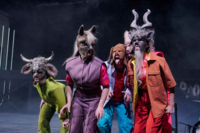
Christian Stückl has been director of the Munich Volkstheater since 2002. Originally from Oberammergau, he became the youngest-ever director of the famous Oberammergau Passion Play in 1987, and directed the play for a fourth time in 2021.
Stückl worked as a director for the Münchner Kammerspiele theatre company until 1996. In parallel to his directorship of the Munich Volkstheater, he also worked as a freelance director for various German-speaking theatres including the Bayerische Staatsoper (opera), Salzburger Festspiele (Salzburg Festival) and Vienna Burgtheater.
Stückl has received numerous awards in recognition of his work, among them the Theaterpreis der Landeshauptstadt München (City of Munich Theatre Award) in 2014, the Bayerische Verfassungsmedaille (Bavarian Constitution Medal) in silver in 2016 and the Abraham Geiger Award for “Services to Judaism in its many faces” and the Toleranzpreis der Evangelischen Akademie Tutzing (Tolerance Award of the Evangelische Akademie Tutzing) in 2020. He was presented with the Buber-Rosenzweig medal in March 2021.

The Volkstheater opened in 1983 near Stiglmaierplatz on Brienner Strasse with a performance of Karl Schönherr’s “Glaube und Heimat”, under then-producer Ruth Drexel. The renowned theatre actress, a graduate of the Otto-Falckenberg-Schauspielschule school of the performing arts in Munich, had herself graced Germany’s stages for years and was part of Bertolt Brecht’s famous Berliner ensemble from 1956 to 1957. In 1989, five years after the theatre opened, she took over as its director.
Cast members at that time included renowned actors such as Gustl Bayrhammer, Beppo Brem, Helmut Fischer, Willy Harlander, Karl Obermayr, Veronika Fitz, Enzi Fuchs, Rita Russek and Maria Singer. During Drexel’s directorship, the theatre’s programme mainly featured works from the traditional popular theatre repertoire. They maintained a connection to contemporary theatre by occasionally working closely with influential playwrights of major theatre pieces such as Franz Xaver Kroetz, who himself also sometimes acted and directed at the Volkstheater.
You can find an overview of the premieres of classical spoken theatre and major music theatres here.