As part of the series “I have never been to …”, our authors explore places in Munich they have never visited before. This time, Eveline Heinrich shares her impressions and feelings from her first visit to the Sudetendeutsches Museum (Sudeten German Museum).
Since it opened in October 2020, I have often walked past the Sudetendeutsches Museum on the high banks of the Isar river near the Gasteig – whether after a stroll along the picturesque Auer Mühlbach (river) or when picking up my son from his nearby school. Each time, I promised myself that I would visit the exhibition soon. So why did it take so many years before I finally did so?
One of the main reasons was possibly the personal memories and emotions I associate with it. My grandparents were Sudeten Germans and their families had lived for centuries in the villages of the German-speaking enclave around Iglau. After the Second World War, they were expelled from their homeland, along with around three million other Germans.
Their stories and their grief over the losses they had suffered shaped my childhood and early adult years until they died.
I remember the stories they told me about their lives before the expulsion – about everyday life in the village, the countryside and, above all, the traditions they loved so dearly. These stories were often overshadowed by grief and loss. And, of course, a love of Bohemian cuisine runs deep in my DNA: that was the taste of my childhood at my grandparents’ house, where my grandmother cooked delicious specialities such as roast pork with sweet-and-sour cabbage and dumplings.
Whilst I was preparing for this article, my colleague Robert spontaneously said he'd like to come along. His father is also a Sudeten German and so we ended up sharing many similar memories of certain aspects of our childhood and upbringing – things that reflect what our parents and grandparents went through.
For example, we both find it very difficult to part with things. Maybe it's a coincidence, but perhaps it’s also the legacy of a childhood shaped by memories of the expulsion, when people could only take the bare essentials with them – and afterwards kept almost everything, because “you might need it again one day”.
“The most important thing in life is to learn as much as possible – because nobody can ever take away what you have in your head.”
Or I catch myself passing on my grandparents' advice and convictions word for word to my own children – advice and convictions that stem from their experience of expulsion and the arduous struggle to make a fresh start. Just the other day, I noticed myself telling them once again: “The most important thing in life is to learn as much as possible – because nobody can ever take away what you have in your head”. I heard this sentence so often from my grandparents and it still fills me with deep respect for what they achieved after their expulsion. Back then, they made it possible for my mother and her two siblings to go to university, even though they had arrived in Franconia as refugees with nothing but the absolute basics.
But now, lets put personal memories aside and turn our attention to the exhibition.
The Sudetendeutsches Museum explores the history of the German-speaking population in the historic regions of Bohemia, Moravia and Sudeten Silesia, which today form part of the Czech Republic. It also sheds light on the long and often difficult coexistence of Germans, Czechs and Jews in the region. To this day, the tragic events before and after the Second World War continue to influence relations between Germans and Czechs – which is why the museum also sees itself as a place of encounter.
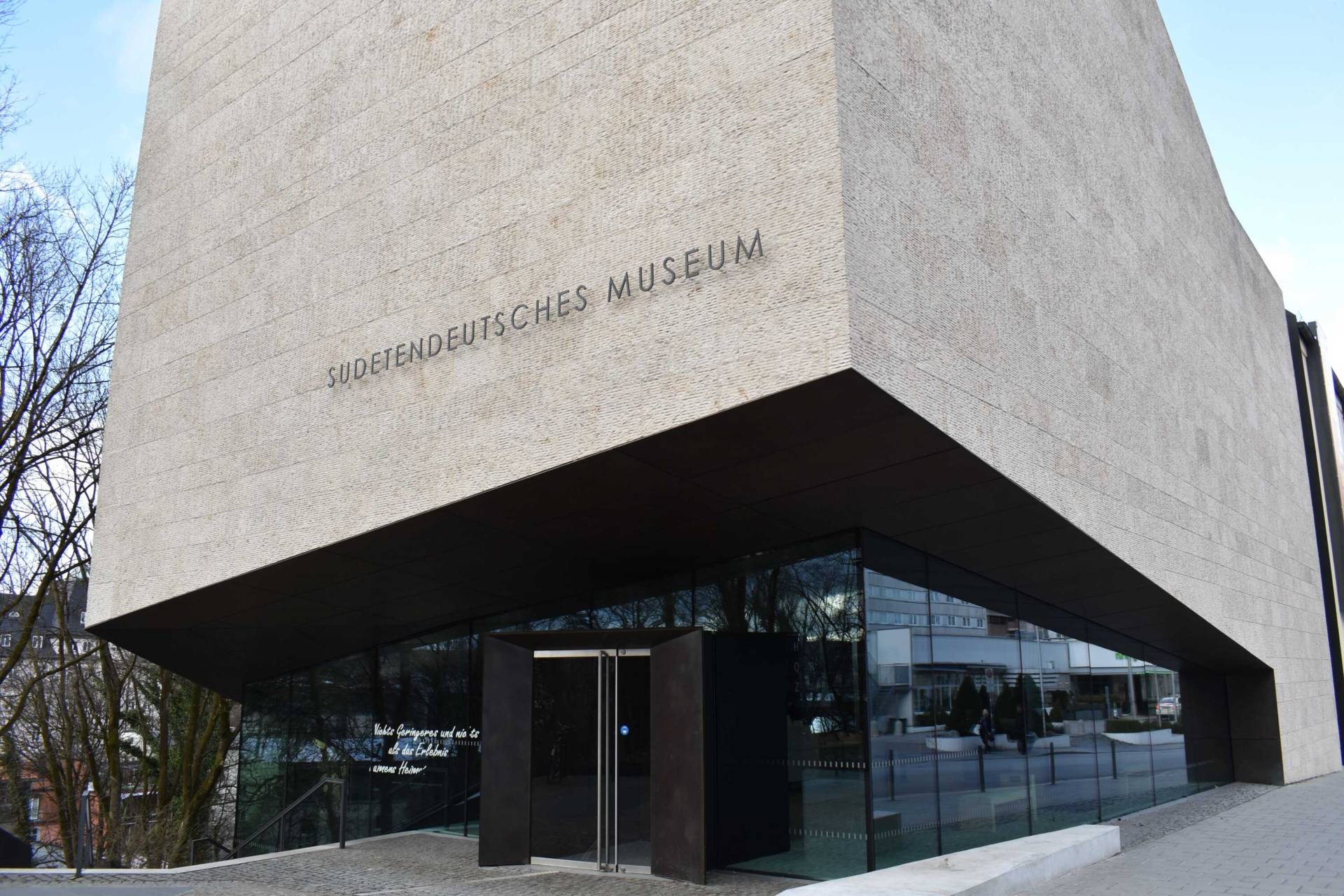
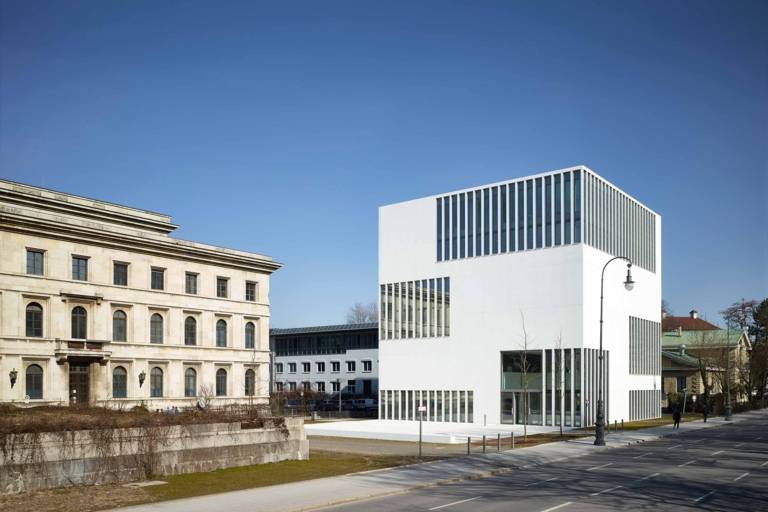
The museum is run by the Sudeten German Foundation and was realised under the patronage of the Free State of Bavaria. Designed by the architectural firm pmp architekten, the building features an impressive light-coloured sandstone façade, making a striking statement on the elevated banks of River Isar.
The permanent exhibition is spread across five levels. Each floor is dedicated to a specific aspect of the life and challenges faced by the Sudeten German population over the centuries.
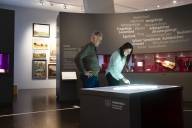
My colleague and I were particularly impressed by the interactive stations, where we could learn more about the places our parents and grandparents came from. There are even historical photographs of these places from that era – and I recognised streets and the church that I had seen in old photographs in my grandparents' living room.
The first level is devoted to the homeland and faith of the Sudeten Germans. There was not a single, continuous settlement area, but rather more than a dozen regions, each with its own dialects, customs and economic activities. It was not until 1919 that all Germans from the various individual home regions were grouped together under the term “Sudeten Germans”. Level 1 also sheds light on the religious practices of the Sudeten Germans, both in their private everyday lives and in public life.
The second level focuses on the economic development of the regions. The economy of the Sudeten Germans had many facets, ranging from agriculture and forestry to mining, a thriving industrial sector and a world-famous spa culture in towns such as Karlovy Vary and Mariánské Lázně. We were particularly fascinated by the world's longest series-produced motorbike of the “Böhmerland” brand – an example of just how innovative local companies were. And, of course, the world-famous Bohemian glass is also on display, including beautiful pieces such as vases and jugs.
This level examines the impact of nationalism, which shaped the second half of the 19th century and the first half of the 20th century. During this period, the paths of Germans and Czechs increasingly diverged, leading to numerous tensions and conflicts over language, education and community life. An economic crisis further exacerbated these difficulties. The exhibition takes a very close look at the political background to the cession of the Sudeten territories to Nazi Germany under the Munich Agreement of September 1938, following the Sudeten crisis provoked by Hitler, and offers a wealth of information through documents, films and images.
The fourth level is particularly poignant and focuses on the years 1945 and 1946, when the Sudeten Germans were forced to leave their homeland – whether by fleeing or being expelled – often after having endured reprisals, internment and forced labour. An installation featuring personal belongings such as prams, handcarts and clothing conveys a vivid sense of the chaos, loss and despair that many people experienced during this period.
This part of the exhibition moved me deeply. My grandmother often told me that her family's small farmhouse had been occupied in June 1945 by a Czech family from the village – and that they were forced to carry out back-breaking work there as farm labourers. They were not allowed to keep anything for themselves, and virtually all the personal belongings and supplies they had hidden away in case they had to flee were taken from them. Cold jacket potatoes, a litte goat's milk and bread were their only food for months on end.
Also public life changed radically: “We were only allowed to walk in the street – not on the pavements – and had to wear a white armband”, I remember my grandmother recounting.
At that time, my grandmother also had to clean the police station in her village and remembered seeing a document there, written in Czech, that ordered the imminent expulsion of several families from the village. She said that she had immediately run from house to house to inform those affected, so that they would have a little more time than the ten minutes stipulated in the document to pack their essentials before they had to leave their homes.
In spring 1946, she and her mother were taken to a resettlement camp. When they arrived, all their food was confiscated and camp life began. After fourteen days, they had to prepare for transport. They had to hand over everything they wanted to take with them.
According to my grandmother's account, this was followed by a “thorough search” in a hall at the sawmill. Children, women and men had to undress in front of the guards so that any piece of jewellery hidden on their bodies could be found. All their clothes and shoes were thrown into a pile.
“Then we were taken to the railway wagons, along with the luggage we had handed over. Around 40 people were crammed into each wagon. The only way to sit or sleep was on your own rucksack. At the station, many more wagons from other camps were then coupled on. By evening, a long train was ready to depart. We travelled via Prague and Plzeň to the border. The doors were locked. During the night, Grandfather Wilhelm died right next to us. The ordeal was simply too much for the old man.”
The final level focuses on the post-war period and the Sudeten German community's new beginning. It highlights their arrival in a new environment, which was often characterised by rejection. In Munich alone, around 52,000 people had to find a new home. Many locals – who were, of course, themselves suffering from hardship and hunger in many regions of Germany – reviled them as “Sudeten crooks”, “backpack Germans”, “Polacks”, “50-kilo gypsies” or “refugee scum”.
The exhibition also shows how the Sudeten Germans found their place in society by helping to rebuild the economy – whilst preserving their old traditions. Today, there are many partnerships with Czech parishes and local authorities that contribute to mutual reconciliation.
“Sudeten crooks, backpack Germans, Polacks, 50-kilo gypsies or refugee scum”
After the border opened, my grandfather often travelled to his former home village and was given permission by the Czech parish priest to consult old church chronicles there. My grandmother, too, had the opportunity to return to her old home several times. Today, I am very happy and grateful that I had the opportunity to travel there with them twice and see for myself everything I knew from their stories.
My visit to the Sudetendeutsches Museum was a deeply moving experience. It was not only a journey into the history of my ancestors but also a chance to understand my grandparents’ experiences within a broader historical context.
Even if you have no direct family connection, a visit to the museum is highly recommended, as it offers a valuable perspective on Europe’s complex history. At a time when understanding different cultures and their histories is more important than ever, it makes a significant contribution to keeping the memory alive and fostering dialogue between different population groups.
More Information about the Political Situation and the Expulsion of the Sudeten Germans
The history of the Sudeten Germans is closely linked to political developments in Central Europe. The German presence in the territories of what is now the Czech Republic – particularly in Bohemia, Moravia and Silesia – dates back to the Middle Ages. In the 19th and early 20th centuries, the term “Sudeten Germans” emerged to describe the German-speaking population in these regions, who developed a stronger sense of identity in the wake of nationalism and the formation of nation-states.
Following the end of the First World War in 1918, Czechoslovakia was founded as an independent state. The Sudeten Germans lived in Czechoslovakia as a significant minority, making up around 23 per cent of the population. Ethnic tensions between the German and Czech communities intensified during the 1920s and 1930s, fuelled by emerging nationalism, the economic crisis and political upheavals in Europe.
With the rise of Hitler and the National Socialist movement in Germany, the political situation continued to deteriorate. In 1938, Germany's increasing aggression and the demands of the German population in the Sudetenland for self-determination led to an international crisis. On 30 September 1938, the Munich Agreement was concluded between Germany, Great Britain, France and Italy. It permitted the cession of the Sudetenland to the German Reich without Czechoslovakia being consulted. Today, the agreement is regarded as an example of appeasement towards Nazi Germany.
In October 1938, the Sudetenland was annexed by the German Reich. During the Second World War, the region was part of the German Reich and the German occupation led to considerable upheaval and persecution.
Following the end of the war in 1945 and Germany's defeat, the German-speaking population was expelled from Czechoslovakia on a large scale. The Beneš Decrees of 1945/46 regulated, among other things, citizenship and expropriation.
Following the so-called “wild expulsion”, marked by severe violence (see the Brno Death March), the process was then organised by the Czech authorities on the basis of the Allied decisions made at Potsdam. This led to great human suffering, as well as the loss of property and cultural heritage. Between 1945 and 1947, around three million Sudeten Germans were forced to leave their homeland. The expulsion remains a controversial issue to this day, as it is viewed both against the backdrop of the preceding events of the war and as a serious violation of human rights.
- Every Thursday at 11 am, the museum offers a drop-in guided tour of the permanent exhibition. (No booking required, no additional cost)
- From July 17, 2026 to January 10, 2027, the special exhibition ‘Human and humane…?’ – The regulated expulsion of the Sudeten Germans – will be on display.
- The Sudeten German Museum is accessible to all. It features tactile guidance paths, tactile and audio stations. In 2026, the museum was even awarded the ‘Barrier-free Bavaria’ seal of approval.
www.sudetendeutsches-museum.de